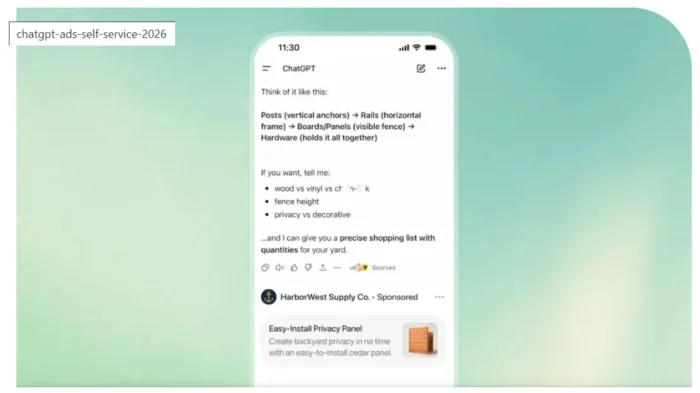
In recent months, advertising on ChatGPT has meant getting an invite. A small group of brands had access. Everyone else waited.
Self-service access is now open to all advertisers, and the dynamics that made early access valuable are already beginning to change.
Key insights
- ChatGPT generated over $100 million in annual advertising revenue in its first six weeks, generated by fewer than 20 percent of eligible users seeing ads daily.
- Around 85 percent of Free and Go tier users are eligible to see ads, meaning current revenue represents only a small fraction of possible ad capacity.
- Self-service access launched in May 2026 and opens the platform beyond the original group of managed pilot brands via a new OpenAI Ads Manager.
- OpenAI has completely eliminated the $50,000 minimum spend, opening the door for companies of all sizes.
- ChatGPT now reaches 800 million weekly active users and processes 2.5 billion prompts daily.
- The first-mover advantage is real and will not last long once self-service competition normalizes pricing.
The numbers behind the market launch
ChatGPT hit $100 million in annual advertising revenue in six weeks, which is a strong opening number on its own. The context makes it even more striking. This value assumes that less than 20 percent of eligible users see ads daily. Since around 85 percent of Free and Go users are eligible to see ads, the platform is only operating at a fraction of its ultimate capacity.
OpenAI launched its self-service ads manager in early May 2026, eliminating the significant minimum spend thresholds that had previously locked out most advertisers. During the pilot phase, entry required a minimum $50,000 commitment, limiting access to major brands and agency partners such as Dentsu, Omnicom, Publicis and WPP.
source
That barrier is now gone. Any US company can sign up, set their own budget and launch campaigns without having to use a partner agency.
The platform has also added CPC and CPM bidding options alongside conversion tracking, pixel-based measurement and attribution features. This infrastructure change is important. It transforms ChatGPT advertising from an experimental awareness product into a channel that can measure performance, allowing advertising ecosystems to properly scale.
Geographic expansion is already underway, with OpenAI confirming launches in Canada, Australia, New Zealand, the United Kingdom, Japan, South Korea, Brazil and Mexico. For international advertisers, now is the time to familiarize yourself with the platform before it reaches your market.
Why this channel works differently
It’s a mistake to move your existing search or social creative into ChatGPT and expect it to work. The environment is fundamentally different.
ChatGPT is a conversation platform. Users engage in dialogue, ask follow-up questions, receive aggregated answers, and make decisions based on the information displayed on the platform. When someone clicks on a Google ad, they are often at the beginning or middle of their research journey. By the time someone encounters an ad in ChatGPT, they have already spent time in a specific, multi-step conversation that has narrowed down their problem. The AI did the clarification and comparison work. The user is ready for a direct answer or a concrete solution.
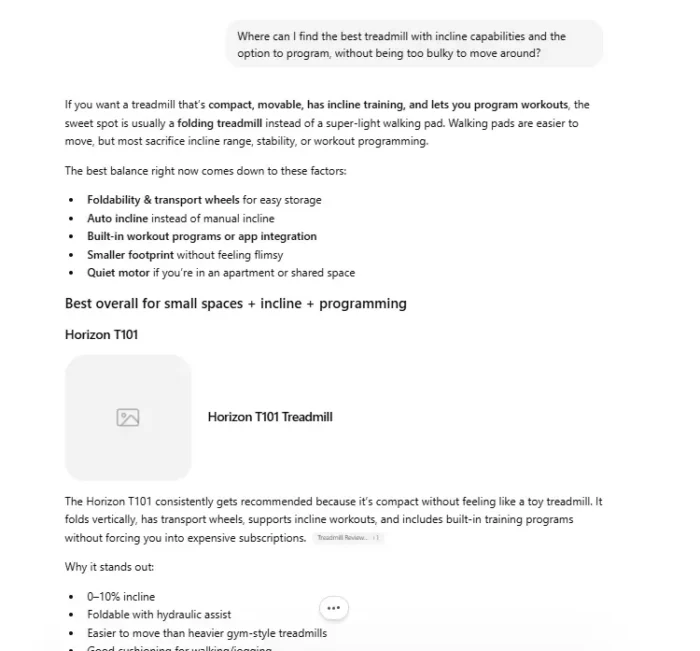
This depth of intent differentiates ChatGPT advertising from display or social advertising. This also means that landing pages and creatives designed for top-of-funnel traffic will underperform. The user who comes through a ChatGPT ad is further along in the decision-making process than the majority of your other paid traffic. Your message and purpose must be consistent with where it is located.
The targeting model is also different. ChatGPT uses contextual matching based on current conversation topics, past chat history and previous advertising interactions instead of traditional keyword targeting or demographic signals. This combination of conversational depth and behavioral context creates a quality of intent signal that search and social networks cannot fully reproduce.
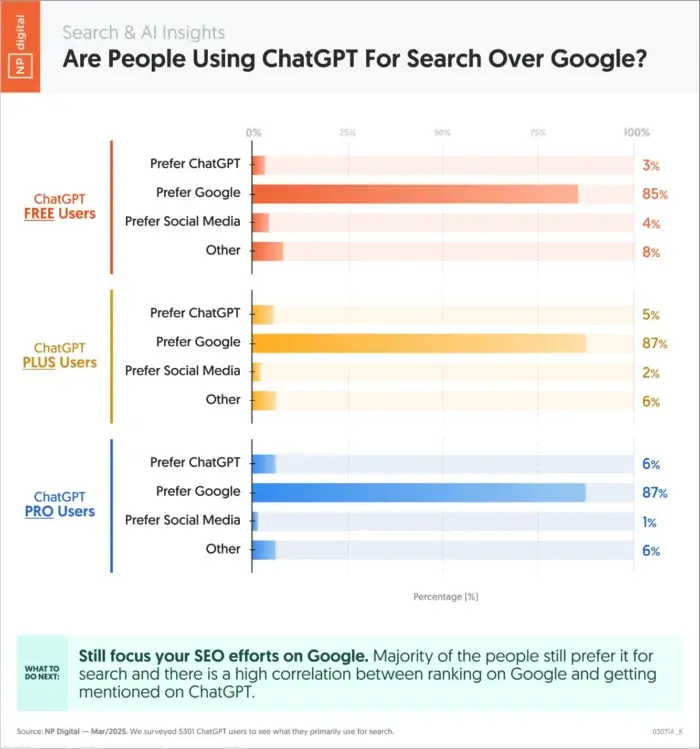
OpenAI has been closely tracking ad quality. Less than seven percent of ads are currently rated as low relevance by users, and the company says improving this metric is an active priority alongside user trust. Initial pilot results showed no negative impact on consumer trust and low ad rejection rates, which OpenAI interpreted as signals to move forward with expansion.
The two ad formats currently running
There are currently two formats live in ChatGPT. Both appear below the AI’s response, clearly marked as sponsored and visually separated from the organic response.
The first is a shopping product carousel with checkout integration. This format works well for eCommerce brands that sell products with clear visual appeal and straightforward paths to purchase.
The second is a conversation banner that includes a call to action and an “Ask ChatGPT about this ad” button. When a user clicks this button, they enter a conversation based on information that the advertiser has preloaded: product details, FAQs and service specifications. ChatGPT answers user questions on behalf of the brand using this uploaded data. A user who asks about pricing, sizes, or features receives a direct, branded response without leaving the platform. This format is particularly suitable for high-value purchases and B2B categories where the questions are complex and the buying cycle is long.
Where the early opportunity is clearest
The categories with the clearest early opportunities are those where users are already turning to ChatGPT for research and decisions. B2B software, professional services, financial products, health and wellness, travel and hospitality, and high-value consumer purchases all fit this profile. These are categories where the purchase decision is complex, the conversation context is rich, and users ask detailed questions across multiple sessions.
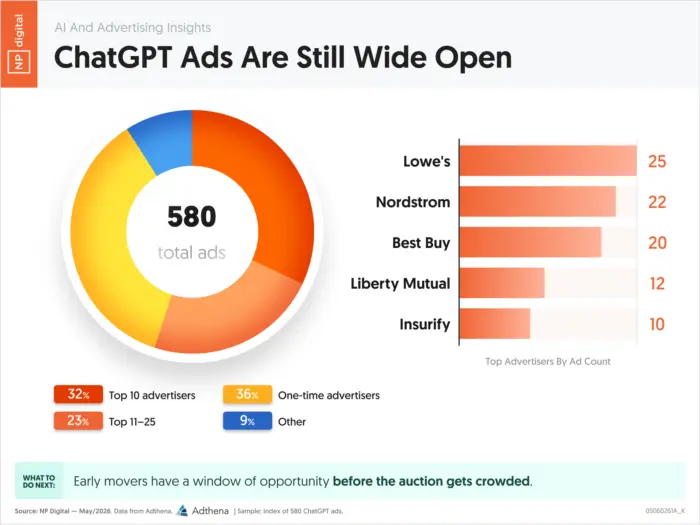
High-priced e-commerce also performs well, especially when users compare specs or ask the AI to evaluate options. Brands that sell bulk or impulse buys at low prices will find that the signal-to-noise ratio is lower, at least in the early stages before expanding format options.
Start by identifying the specific questions users are asking ChatGPT that relate to what you sell. Use ChatGPT yourself to research these queries: The language the AI naturally uses to discuss your category is a preview of the context in which your ads will appear. Target your messages to this language. These query moments correspond to high-intent keywords in early search, and there is currently low auction pressure around them.
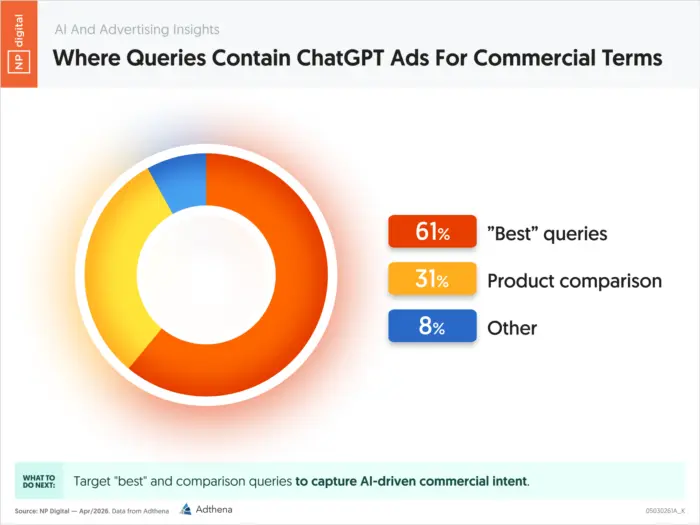
Set a testing budget and think of it as education. A modest budget in the first few months of self-service access should be viewed as a learning curve about what works in the context of conversational ads, rather than a channel expected to deliver strong ROAS immediately. The data you create now will become more valuable as the platform scales.
The bigger picture
ChatGPT’s ad launch is part of a broader shift in the way discovery works. The platform now processes 2.5 billion daily prompts from 800 million weekly active users. This is not a niche experiment. It’s a mainstream consumer behavior that brands need to take into account.
The parallel to early search engine advertising is not far-fetched. Google Ads in 2002, Facebook Ads in 2007, and ChatGPT Ads in 2026 follow the same pattern: access was initially limited, costs were low, and the brands that moved early built structural advantages that compounded over time. OpenAI is targeting $2.5 billion in advertising revenue by 2026, with longer-term projections to reach $100 billion by 2030. By comparison, AI-driven search ads are expected to reach $26 billion by 2029, representing 13.6 percent of total search advertising spending in the United States.
The window for early adoption with low competition is now open. It won’t stay that way.
FAQs
Do ChatGPT ads influence what the AI says in its responses?
No. OpenAI has specifically stated this point: Ads have no influence on ChatGPT responses. Sponsored content is always visually separated from the organic reaction and clearly marked. Advertisers only receive aggregated performance data. Individual conversations remain private.
Who can see ChatGPT ads?
Currently, ads are only shown to logged in adult users on the Free and Go plans. Users of the Plus, Pro, Business, Enterprise and Education tariffs will not see any advertising. This means that the addressable audience is the tens of millions of people who use the free version of ChatGPT.
How is ChatGPT ad targeting different from Google or Meta?
ChatGPT targeting is based on current conversation context, past chat history, and previous ad interactions, rather than demographics or keywords. This gives you access to a deeper intent signal than behavioral or interest-based targeting can provide.
What should my landing page look like for ChatGPT traffic?
Not like a generic homepage. Users who arrive through ChatGPT ads have already had a specific, contextual conversation. Your landing page should address this context directly: it should match the problem being discussed, provide the specific answer or solution they are looking for, and make the next step clear.
{ “@context”: “https://schema.org”, “@type”: “FAQPage”, “mainEntity”: [
{
“@type”: “Question”,
“name”: “Do ChatGPT ads affect what the AI says in its responses?”,
“acceptedAnswer”: {
“@type”: “Answer”,
“text”: “
No. OpenAI has been explicit on this point: ads do not influence ChatGPT’s answers. Sponsored content is always visually separated from the organic response and clearly labeled. Advertisers receive only aggregated performance data. Individual conversations stay private.
”
}
}
, {
“@type”: “Question”,
“name”: “Who can see ChatGPT ads?”,
“acceptedAnswer”: {
“@type”: “Answer”,
“text”: “
Currently, ads are shown to logged-in adult users on the Free and Go plans only. Users on Plus, Pro, Business, Enterprise, and Education plans see no ads. That means the addressable audience is the tens of millions of people on the free version of ChatGPT.
”
}
}
, {
“@type”: “Question”,
“name”: “How is ChatGPT ad targeting different from Google or Meta?”,
“acceptedAnswer”: {
“@type”: “Answer”,
“text”: “
ChatGPT targets based on current conversation context, past chat history, and previous ad interactions rather than demographics or keywords. This gives you access to a deeper intent signal than behavioral or interest-based targeting can provide.
”
}
}
, {
“@type”: “Question”,
“name”: “What should my landing page look like for ChatGPT traffic?”,
“acceptedAnswer”: {
“@type”: “Answer”,
“text”: “
Not like a generic homepage. Users arriving from ChatGPT ads have already had a specific, contextual conversation. Your landing page should acknowledge that context directly: match the problem they were discussing, provide the specific answer or solution they are looking for, and make the next step clear.
”
}
}
]
}
Diploma
$100 million in annual revenue from less than 20 percent of eligible users in six weeks is not a humble beginning. As self-service grows, the minimum spend limit is eliminated, and the eligible audience grows, these numbers will rise quickly.
Move early. Set standards. Learn how conversational advertising works in your category. The waiting time is higher than the cost of the test.
Follow us on Facebook | Twitter | YouTube
WPAP (697)
