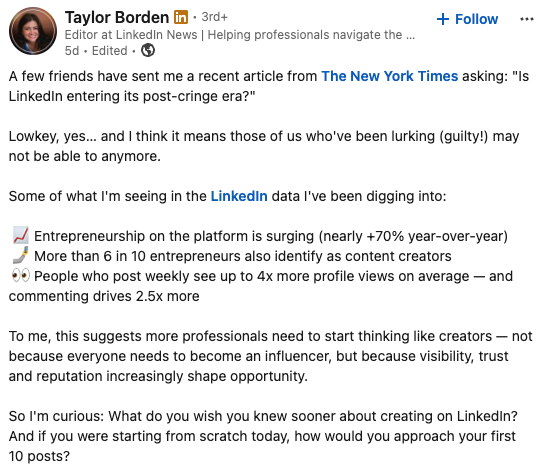
Taylor Borden, an editor at LinkedIn, emailed me last week with a question she’s asking a handful of writers for a special edition of her newsletter, The Work Shift. The assumption was supported by data showing that entrepreneurship on LinkedIn has increased by almost 70% compared to last year, more than six in ten of these entrepreneurs also identify as content creators, and people who post weekly see up to four times more profile views, with commenting leading to 2.5 times more.
Her question was simple: What lesson changed your approach to content creation? And if you were starting your LinkedIn journey from scratch, how would you approach your first 10 posts?
I almost responded with a frame. Then it occurred to me why frameworks are the problem.
4 categories felt complete. The data did not match
Around 2009, Guy Kawasaki asked me for a few pages for his book Enchantment: The Art of Changing Hearts, Minds, and Actions. I’ve shared four ways brands can create YouTube videos that truly engage their audiences: inspire viewers with emotional stories, educate them with useful information, enlighten them with documentation, or entertain by making her laugh.
Four felt complete. It was clear, educational and easy to remember. I used it. Other people have used it. Years later, I even incorporated it into an article for Search Engine Journal: “What is a Content Marketing Matrix and Do We Need One?”
Then data kept arriving. In 2023, I wrote another SEJ article with not four, but 39 emotions – count them.
I had never connected these two parts until Borden’s email forced me to. The gap between them, 14 years and 35 emotions, is the most useful thing I’ve learned in the 24 years I’ve been writing about this industry. The four-category system was not wrong when I wrote it. It was just the size of the dataset I had access to at the time. The mistake would have been to consider it finished.
The practitioners who get stuck are the ones who fall in love with their system
This is the part of my answer to Borden that applies directly to anyone doing SEO, content marketing, or social media marketing right now, and not just LinkedIn posts.
Every framework you create, every category system, every “the four types of X” or “the five stages of Y” is a snapshot of what the evidence showed you on the day it was created. AI overviews didn’t exist when most of our content frameworks were written. Neither AI mode, Gemini’s embedded search, nor AI overviews appeared in the results of 2.5 billion users. The frameworks created for a world with 10 blue links were not wrong for this world. They only correspond to the size of the data set that existed at the time.
The practitioners who get stuck are the ones who continue to apply the 2019 framework to the 2026 data because the framework is familiar and the new data is impractical. Those who continue to grow remain curious enough to ask, “What would this framework look like if I were to rebuild it today, with everything I know now that I didn’t know then?”
This is exactly the trap that many AI overview content strategies are currently falling into. The “Answer the query in 40 words at the top of the page” framework was built for a world where the goal was to win a featured snippet. This framework was not wrong for this world. But AI overviews don’t reward the side that has already said it all; They reward the page a user clicks to after the overview, and they reward them for being more than the summary that sent them there. A page built to adopt the old framework is inherently the page that no longer has anything to offer the user. The four-category model and the 40-word response model failed for the same reason; Both were finished products, built for a data set that continued to grow after the deadline.
What I would say to anyone starting their first 10 posts
This is the answer I gave Borden directly, and it’s the same advice I would give to anyone starting out in SEO, content marketing, or social media marketing, whether on LinkedIn or elsewhere.
Find something you confidently believe in. Then find the research that complicates it. Write honestly about the gap, including the part where you were wrong or incomplete.
This single step does three things at once. It gives you a topic (your existing belief), it gives you a hook (the data that challenges it), and it gives you credibility that a sophisticated, unchallenged framework can never achieve, because readers can tell the difference between someone taking a position and someone actually updating it.
2 steps to use this week
Start by going to the oldest framework, list, or “The X Types of Y” article that you have published, that you are most proud of, and that is still cited or linked to. Search for publications on this exact topic in the last 12 months. If a four-category framework from 2009 had to quietly go up to 39 by 2023, anything you wrote in 2019 or 2021 will almost certainly have a similar gap in the data for 2026. Don’t defend the old version. Write the article updating it and be explicit about what has changed and why.
Second, before you publish something called “the X ways to do Y,” ask whether you are presenting a snapshot or a conclusion. In a snapshot it says: “This is what the findings show so far, and I assume that this number will continue to rise.” A conclusion states: “This is the complete list.” The first frame is aging well. The second frame is the one where you have to go back in front of an audience, like I just did with my own frame from 2009, in public, 14 years later.
The entrepreneur data Borden shared, the 70% growth and four times the profile views for weekly posters, isn’t really about LinkedIn specifically. It’s evidence that more people are now doing what authors and SEO practitioners have always done, which is to believe in the public and often quickly find out whether the evidence agrees with it. The lesson is the same in both cases. Stay tuned to see what the data says next, especially if it doesn’t match the framework you’ve already published.
Additional resources:
Featured image: Roman Samborskyi/Shutterstock
Follow us on Facebook | Twitter | YouTube
WPAP (907)
