Key insights
- AI shopping agents have raised consumer expectations for personalization far beyond name tokens and basic segmentation.
- Zero-party data (information that customers share directly) and first-party behavioral data are the most powerful inputs for personalized email programs.
- Advanced segmentation, conditional logic in automations, and predictive churn modeling are the tactics that separate high-performing email programs from average ones.
- Personalization leads to measurable increases in conversion rates, customer retention rates and ROI across industries.
- Each email service provider (ESP) has different capabilities, but any increase in personalization tends to move performance metrics in the right direction.
The “Hello, [first name]The mark used to “feel personal in a subject line. Today it’s barely noticed. Consumers have seen it so often that it’s interpreted as the absence of personalization rather than the presence of it.”
AI has changed the possibilities in email marketing and with it people’s expectations. AI-powered purchasing agents can now predict what a customer wants before they have searched for it. If that’s the point of comparison, a generic batch-and-blast email doesn’t just perform worse. It actively signals that your brand is not paying attention.
Here’s what email personalization will actually look like in 2026 and how to develop a strategy that can keep up.
Why the personalization bar was moved
Consumers have always wanted to feel like they are more than just a number on a list. This is not new. What’s new is the yardstick by which they measure you.
AI-powered shopping assistants, personalized recommendation engines, and other AI marketing tools have made highly contextual experiences the norm. If a consumer’s phone already knows that a product they regularly buy is running low, or if a shopping agent displays the exact item they were about to search for, their tolerance for general email content decreases proportionately.
Klaviyo research consistently shows that personalization based on zero-party and first-party data leads to higher conversion rates, better customer retention and higher ROI across industries. The brands that are seeing these results aren’t relying on panacea tactics, but are using better data and more conscious segmentation to deliver messages that actually resonate with the person receiving them.
The brands that don’t do this are easier to ignore or unsubscribe from.
The data basis: zero-party vs. first-party
Before you can personalize effectively, you need the right input. Two data types are most important here.
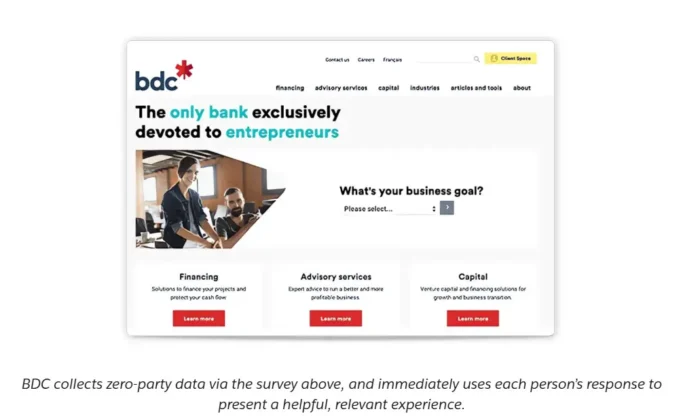
Zero Party Data (ZPD) is information that a customer gives you directly and intentionally. Product preference quizzes, style surveys, onboarding forms asking about goals or challenges, and opt-in preference centers generate ZPD. The customer knows they are sharing it and chooses to do so. This intention makes it extremely reliable.
source
First-party data is behavioral: purchase history, browsing activity, email interaction, content interactions. You collect it passively through your own channels. It reflects what customers actually do, which often differs from what they say.
The most effective email programs introduce both types of data into a unified customer profile and use that profile to drive segmentation, automation logic, and send timing. Executing these as separate actions is one of the most common gaps in email strategy. The brands that make the most of personalization view ZPD collection as a systematic part of the customer journey, starting with onboarding, rather than an occasional survey blast.
What advanced email personalization actually looks like
Generic segmentation by geography or purchase category is a starting point, not a strategy. This is what going beyond the basics looks like in practice.
Conditional logic in automations
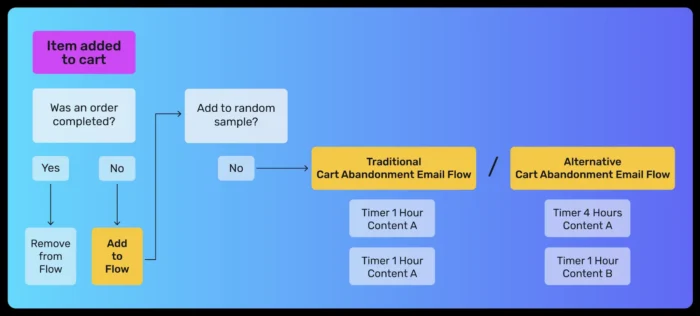
Take the abandoned cart workflow as a representative example. Most brands send a single recovery email to everyone who gives up. A better approach uses conditional splits based on cart value.
source
A customer with $250 in their cart is unlikely to give up because they need a discount. They may need a confirmation, a review, or a reminder. A customer with $35 in their cart might convert with a 10 percent offer. If you treat these two scenarios with the same message, you’re ignoring obvious signals you already have.
The same logic applies to your welcome series, post-purchase flow, and win-back campaigns. Conditional splits allow you to match the message to the moment instead of averaging your list.
AI segmentation for churn prevention
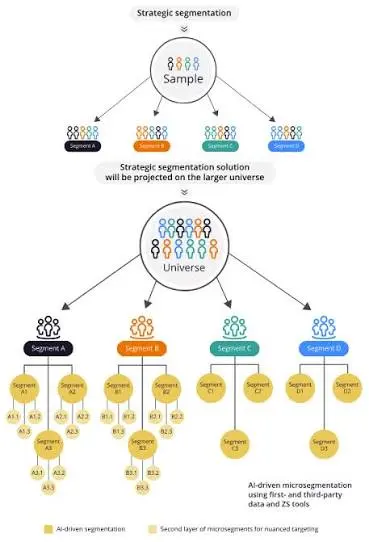
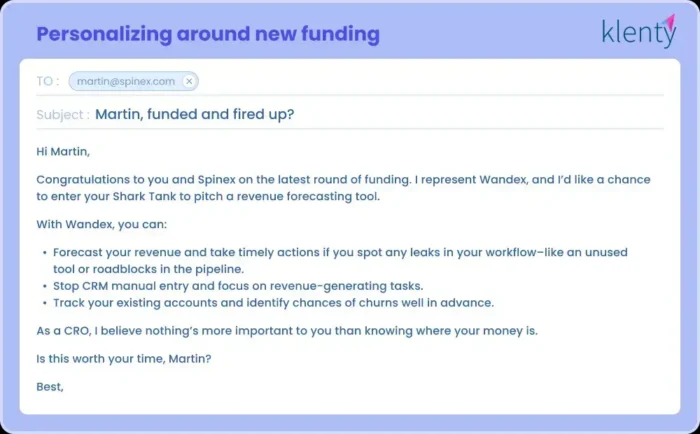
Waiting until a subscriber unsubscribes to win them back is too late. AI segmentation tools can identify subscribers at high risk of churn before they churn based on patterns of decline in engagement, changes in purchasing cadence, and behavioral signals.
source
Reaching these subscribers at the right moment with a relevant message is far more effective than a reactive win-back campaign three months after they have fallen silent. A targeted re-engagement email with a personalized offer based on purchase history outperforms a generic “we miss you” message sent to a cold list segment.
source
Behavioral triggers for scheduled mailings
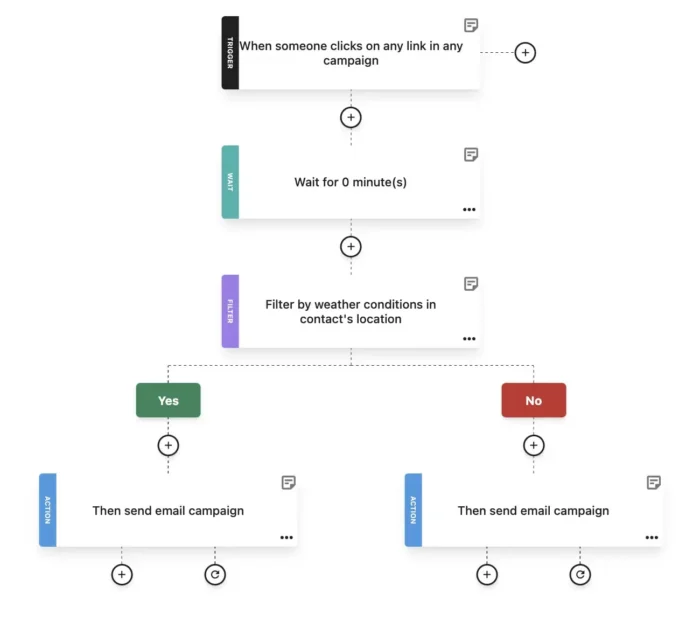
Scheduled newsletters have their place, but the best-performing email programs are increasingly event-driven. A customer who views a product page three times without purchasing anything is now a better candidate for a targeted email than for your next weekly send.
source
Setting up behavioral triggers requires more upfront work, but creates messages that arrive when the customer’s interest is actually active. This time advantage is difficult to reproduce with a fixed broadcast schedule.
Personalization beyond the subject line
Subject line personalization is the most visible level, but email body content, product recommendations, and calls to action can all be personalized based on the data you have. Dynamic content blocks allow you to send different images, text, or offers to different segments within a single email send.
For e-commerce brands, product recommendations based on purchase history and browsing data are one of the clearest performance drivers in email. According to a study by Klaviyo, personalized product recommendations in emails consistently outperform static content blocks in conversion and click metrics.
Building a More Personalized Email Program: Where to Start
You don’t have to overhaul your entire program at once. Incremental personalization improvements add up. Here’s a handy order:
- Review your current segmentation. If you’re sending the same email to your full list without behavior or preference-based splits, this is the first thing you need to address.
- Add a ZPD collection touchpoint to your welcome flow. A quick preference survey, product recommendation quiz, or style selection upon signup gives you first-party intent data that you can act on immediately.
- Create a conditional split into an existing automation. Your abandoned cart or welcome series is the right place to start. Select a variable (cart value, product category, source of purchase) and divide it accordingly.
- Check your suppression logic. Are you sending promotional emails to customers who have just made a purchase? Send re-engagement campaigns to active subscribers? Small gaps like these undermine the experience in ways that accumulate over time.
- Separate your measurement. Track personalized segments and general sends independently. Conversion rate, click-through rate and unsubscribe rate provide information about whether personalization is working. Without separate tracking, you are flying blind.
There will be some limits to your ESP’s capabilities here, but most platforms support at least basic segmentation and conditional logic. Start with what is available and build from there.
FAQs
What is email personalization?
Email personalization is the process of tailoring email content, timing, and offers to individual recipients based on data about their preferences, behaviors, and past engagement with your brand. It goes far beyond name tokens and includes segmentation, dynamic content, behavior triggers and predictive recommendations.
What is zero-party data in email marketing?
Zero-party data is information that a customer shares with you directly and intentionally, such as quiz answers, stated product preferences, or responses to onboarding surveys. It is different from first-party data, which is collected through observed behavior such as browsing and purchase history. Both are valuable inputs for personalization.
How does AI improve email personalization?
AI tools improve email personalization in several ways: by identifying subscribers at high risk of churn before they unsubscribe, by powering product recommendation engines that display relevant items based on purchase history and browsing behavior, and by enabling more sophisticated segmentation than manual rule creation allows.
Which email segmentation strategies work best?
Behavioral segmentation outperforms demographic segmentation in most cases. Splitting by purchase history, engagement level, browsing behavior and acquisition source results in more relevant news than splitting by age or location alone. Combining behavioral data with ZPD preference data gives you the sharpest segments.
Do I need a new ESP to improve personalization?
Not necessarily. Most ESPs support basic segmentation and conditional logic. The bigger gap is usually in data collection and workflow design, not platform capability. Start improving your ZPD collection and segmentation logic before assuming your current platform is the limitation.
{ “@context”: “https://schema.org”, “@type”: “FAQPage”, “mainEntity”: [
{
“@type”: “Question”,
“name”: “What is email personalization?”,
“acceptedAnswer”: {
“@type”: “Answer”,
“text”: “
Email personalization is the practice of tailoring email content, timing, and offers to individual recipients based on data about their preferences, behaviors, and history with your brand. It goes well beyond name tokens to include segmentation, dynamic content, behavioral triggers, and predictive recommendations.
”
}
}
, {
“@type”: “Question”,
“name”: “What is zero-party data in email marketing?”,
“acceptedAnswer”: {
“@type”: “Answer”,
“text”: “
Zero-party data is information a customer shares with you directly and intentionally, such as quiz responses, stated product preferences, or answers to onboarding surveys. It differs from first-party data, which is collected through observed behavior like browsing and purchase history. Both are valuable inputs for personalization.
”
}
}
, {
“@type”: “Question”,
“name”: “How does AI improve email personalization?”,
“acceptedAnswer”: {
“@type”: “Answer”,
“text”: “
AI tools improve email personalization in a few ways: by identifying high-risk churn subscribers before they disengage, by powering product recommendation engines that surface relevant items based on purchase history and browsing behavior, and by enabling more sophisticated segmentation than manual rule-building allows.
”
}
}
, {
“@type”: “Question”,
“name”: “What email segmentation strategies work best?”,
“acceptedAnswer”: {
“@type”: “Answer”,
“text”: “
Behavioral segmentation outperforms demographic segmentation in most cases. Splitting by purchase history, engagement level, browsing behavior, and acquisition source produces more relevant messages than splitting by age or location alone. Combining behavioral data with ZPD preference data gives you the sharpest segments.
”
}
}
, {
“@type”: “Question”,
“name”: “Do I Need a New ESP to Improve Personalization?”,
“acceptedAnswer”: {
“@type”: “Answer”,
“text”: “
Not necessarily. Most ESPs support basic segmentation and conditional logic. The bigger gap is usually in data collection and workflow design, not platform capability. Start by improving your ZPD collection and segmentation logic before assuming your current platform is the constraint.
”
}
}
]
}
Diploma
Email personalization in 2026 means understanding what your customers are looking for before they tell you and sending the right message at the right moment. This is a different standard than what most email programs currently work with.
The good news is that the inputs are mostly in your control. Zero-party data collection, conditional automation logic, and behavioral segmentation do not require a major platform overhaul. They require a more conscious approach to collecting, organizing and using the data we already have. You can also work with the NP Digital team if you need practical help building a smarter email personalization strategy.
Follow us on Facebook | Twitter | YouTube
WPAP (697)
