AI draws its knowledge from three different levels: training data, retrieval systems and live tool access such as APIs and MCPs.
Each data layer has its own advantages and disadvantages. So if you’ve ever wondered why an AI confidently told you something wrong, why one tool seems to know about last week’s news and another doesn’t, or why your competitor’s product gets tons of mentions but yours doesn’t, the answer almost always comes down to which layer answered your question.[/intro_text]
This article explains in plain language where AI knowledge actually comes from – and why it matters how much you should trust a particular answer.
Before an AI model ever answers a single question, it goes through a phase called training.
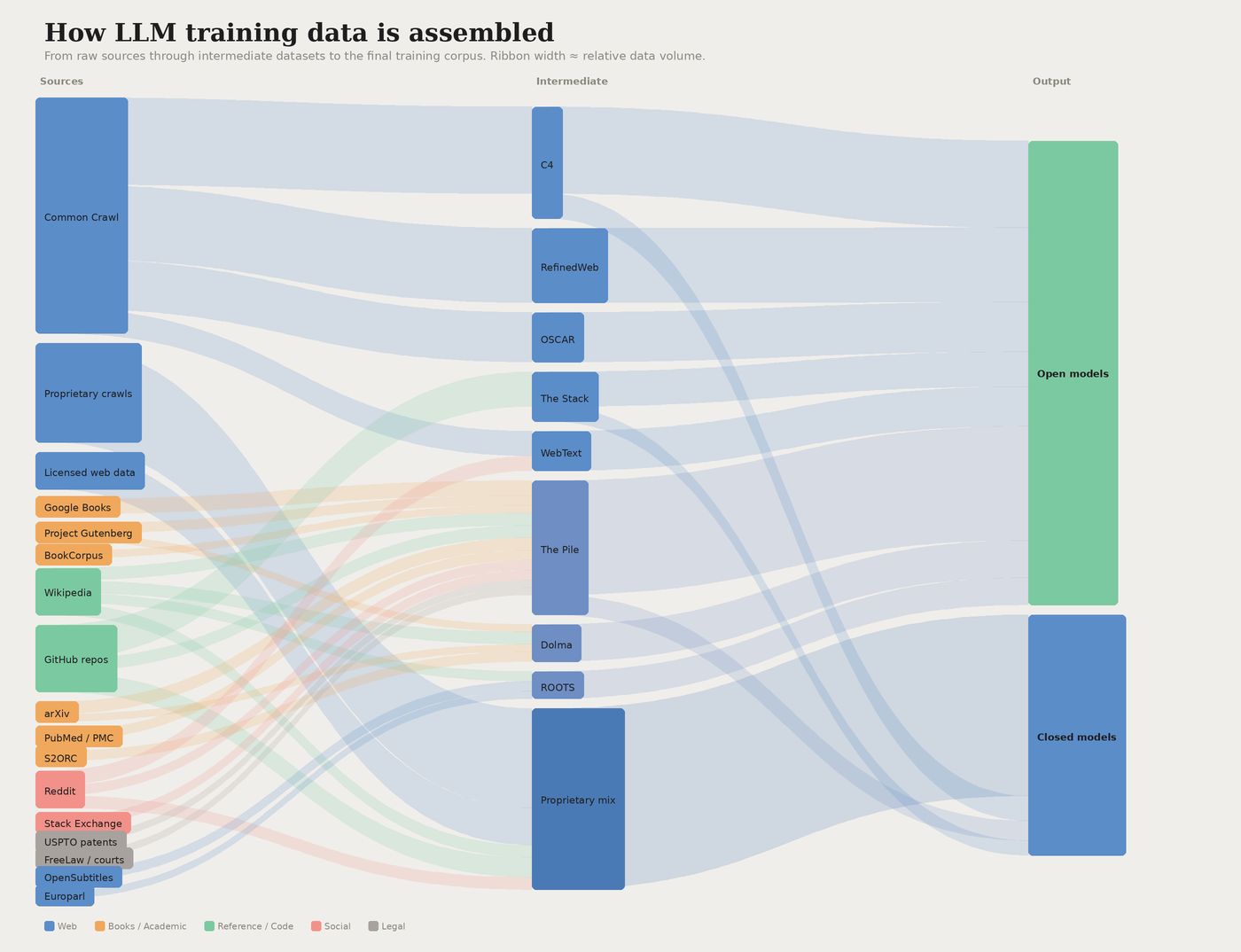
During training, the model ingests billions of text, images and code samples – public web crawls, books, Wikipedia, code repositories, licensed databases – and learns to predict patterns across domains. By the end of the training, the model has effectively memorized a statistical snapshot of human knowledge up to that point.
A visualization of common data sources used in training large language models.
This is how AI models develop their “understanding” of the world. The presence of different entities in the training data (like your brand name or products: think “Patagonia” or “Nanopuff Hoody”) and the words they frequently appear with (like “eco-friendly” or “high quality”) shape the model’s understanding of your brand.
As Gianluca Fiorelli explains:
LLMs learn the relationships between your brand and concepts like “gym” or “noise cancellation.” These semantic associations have a direct influence on whether and how you are mentioned.

The extent of the training is hard to imagine. Training data for important models is measured in trillions of tokens (roughly blocks of words). The cost gives you an idea of what it takes: GPT-4’s training cost an estimated $78 million; Google’s Gemini Ultra cost around $191 million.
The global market for AI training datasets was $3.2 billion in 2025 and is expected to reach $16.3 billion by 2033 – a 22.6% annual growth rate that reflects how central data has become to the entire enterprise.
Here’s the most important thing to understand: once training ends, the model’s knowledge is frozen. It cannot learn from new events. It has no idea what happened yesterday, or last month, or whatever date its training data was truncated after.
Some vendors periodically refine their models based on newer data, but this is still a discrete process – more like releasing a software update than constantly reading the news.
The other major failure mode is hallucination. When a model doesn’t have reliable training data to draw on, it fills the gap with something that sounds plausible – a made-up quote, a made-up statistic, a confident non-answer (like Google’s AI Overview, which cites an April Fools’ Day satirical article as a factual source).
The model couldn’t tell that the article was a joke; It just looked authentic enough to fit the pattern.
Retrieval-Augmented Generation (RAG) is the main technique to circumvent the knowledge cutoff problem.
Instead of relying solely on what the model learned during training, RAG lets the model retrieve relevant documents the moment a question is asked, and then use those documents as context when generating an answer.
Think of it as the difference between a closed book exam and an open book exam. A pure training model must answer from memory. A RAG-enabled model can look things up first and then respond. The result is more up-to-date and, in principle, easier to check because the answer is based on actually retrieved content and not on statistical pattern comparisons.
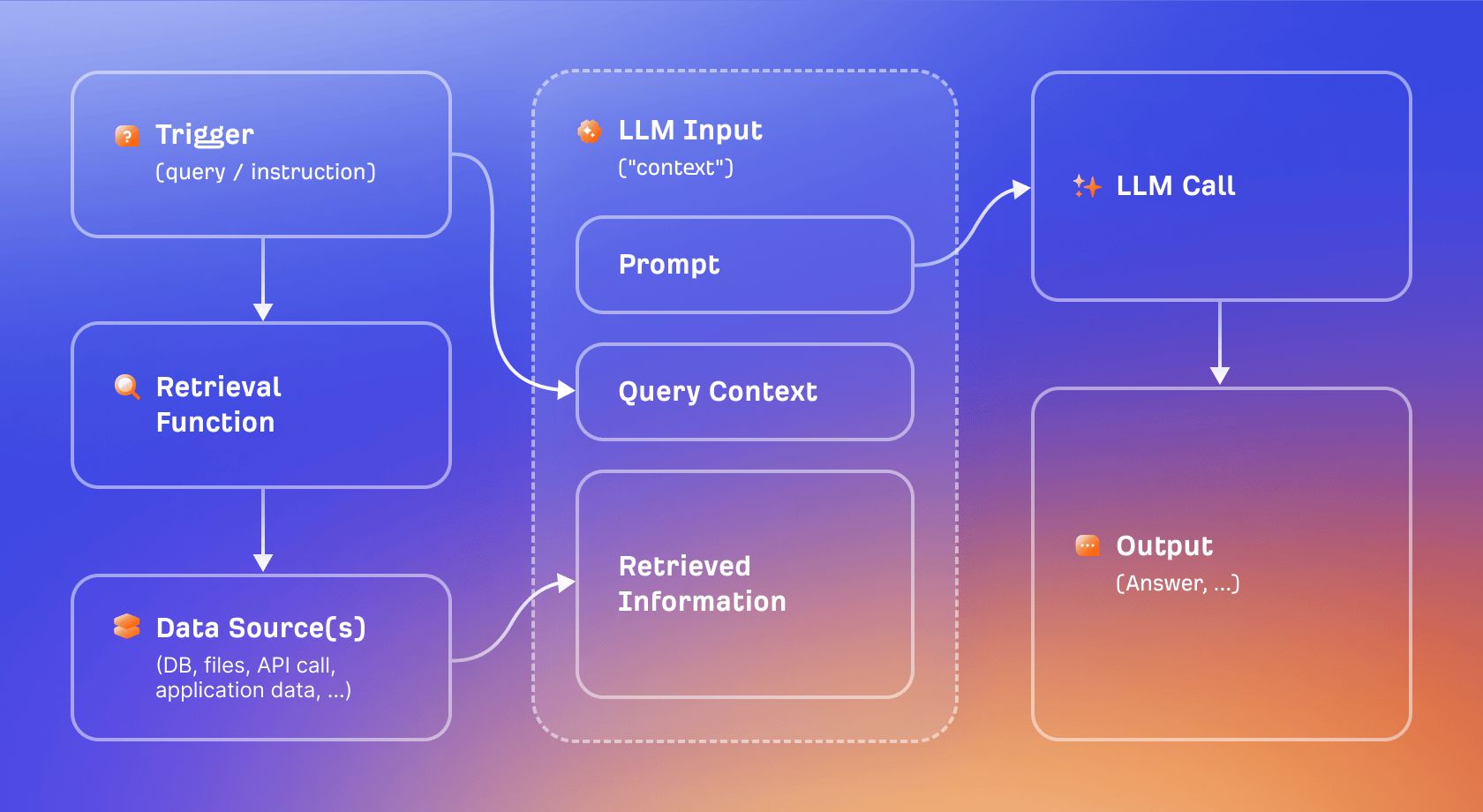
Retrieval of the extended generation visualized.
“Grounding” is the broader term for this anchoring. Once an AI answer is determined, it is tied to specific retrieved sources, dramatically reducing the risk of hallucinations.
As Britney Muller explains:
Grounding comes from ground truth, which is rooted in statistics and originally in cartography, where it literally meant going outside to check whether the map matches reality.

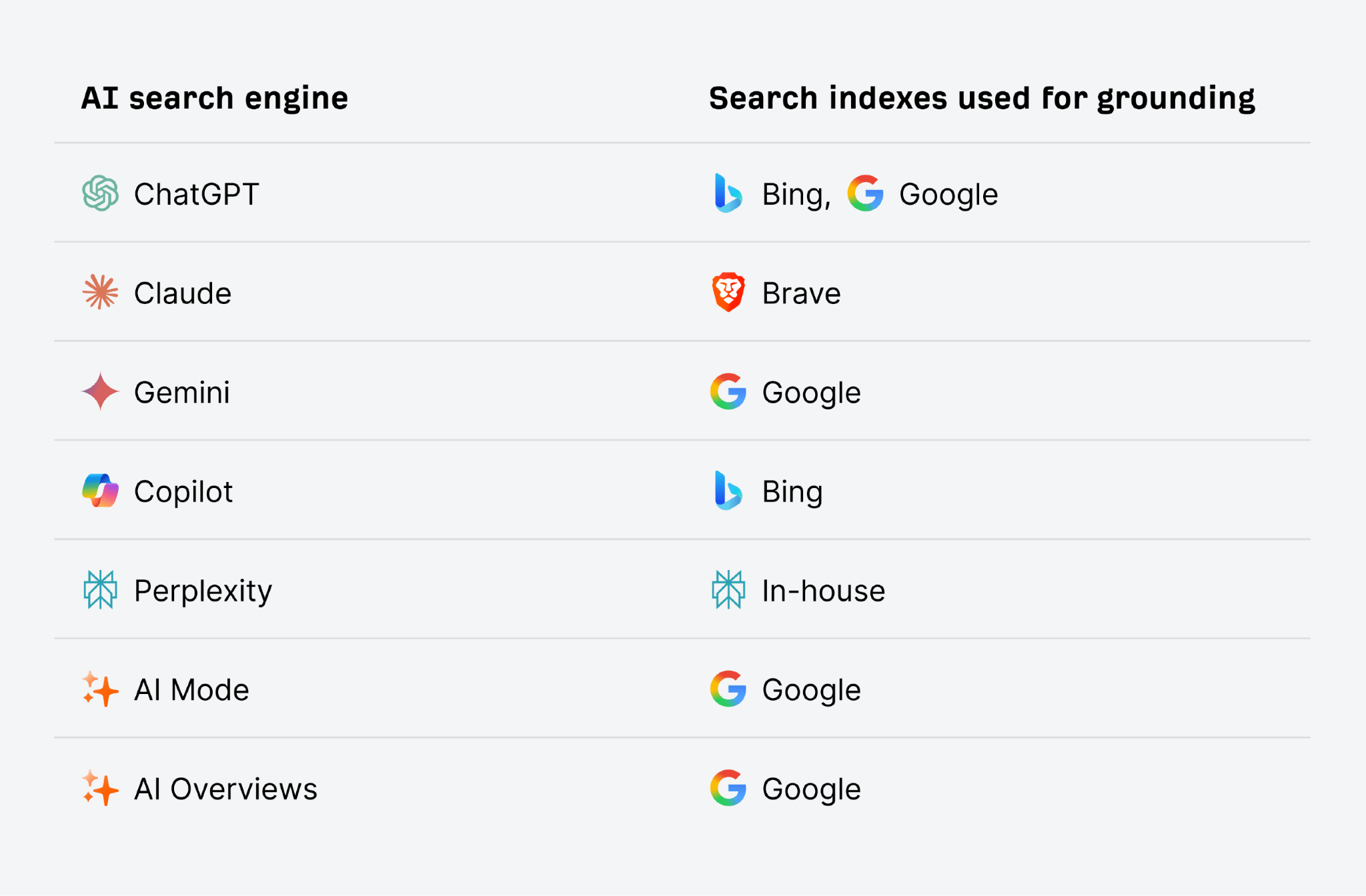
AI search engines like ChatGPT and Gemini use traditional search indexes like Google and Bing for this grounding process. For this reason, good search engine optimization and a high ranking in traditional search also improve the visibility of your AI. The higher you appear in the search index for the term the AI is looking for, the higher your chance of being found and quoted in the answer.
Not every AI product uses RAG. For example, a basic ChatGPT session with browsing disabled is purely training-based: it has no access to up-to-date information and no way to verify its answers against live sources.
The trade-off is speed and simplicity. Answers that are only tailored to training become outdated quickly, but permanently. RAG increases latency and introduces a new failure mode (fetch failure – reading the wrong source or a poor quality source), but allows for freshness.
RAG is a way to incorporate new information into an AI response. But modern AI systems are going further and giving models the ability to call up external tools during the conversation. This is AI agent territory.
An AI agent doesn’t just retrieve documents; It can query APIs, perform searches, execute code, and interact with live data sources as part of processing a task.
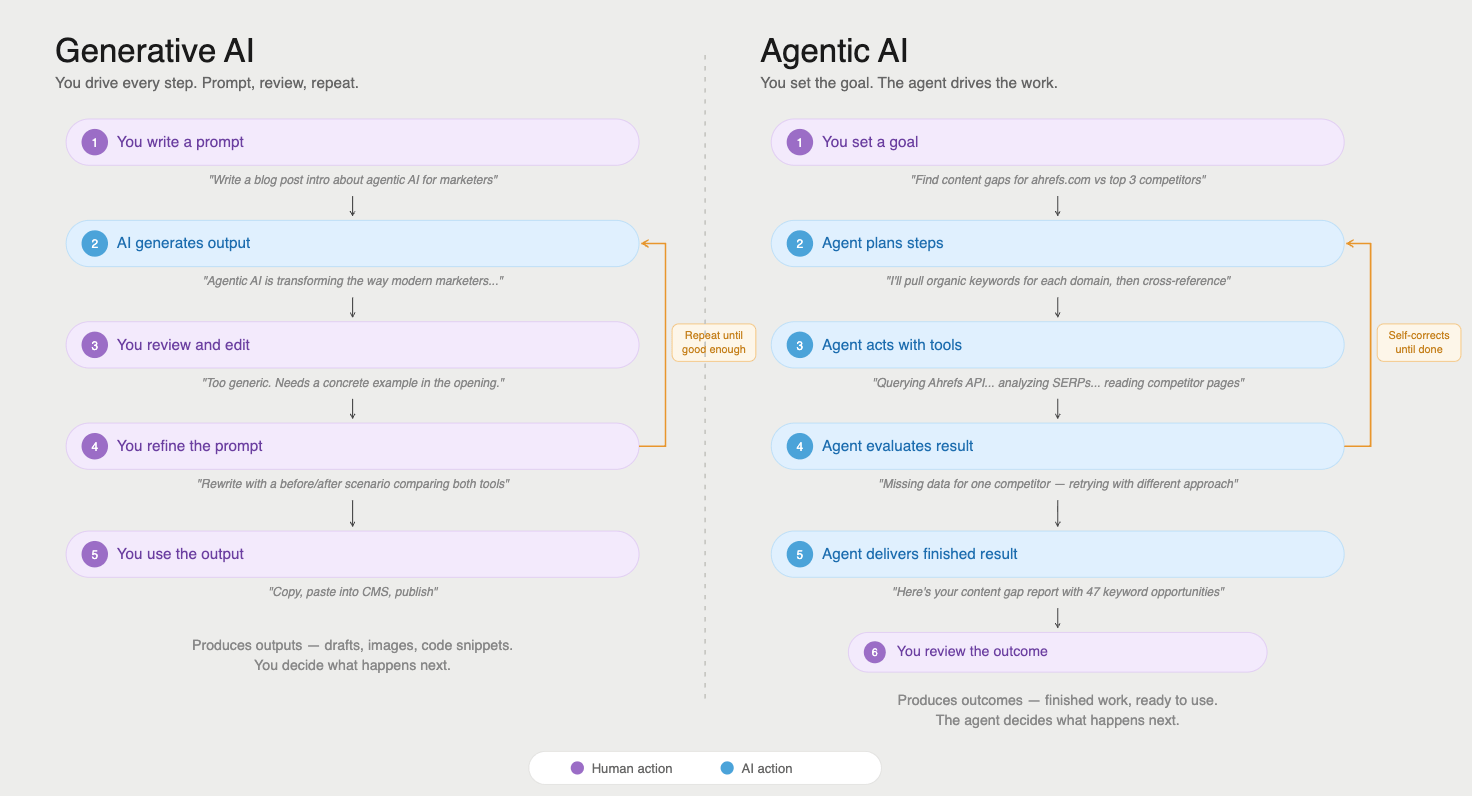
A comparison of the use of generative AI with agentic AI.
The resulting infrastructure for this is called Model Context Protocol (MCP), a standard that allows AI models to connect to external data sources in a structured way.
A concrete example: Ahrefs has an MCP integration that allows AI agents to query Ahrefs data directly during a task and retrieve keyword metrics, backlink data or competitive intelligence without the user leaving their workflow.
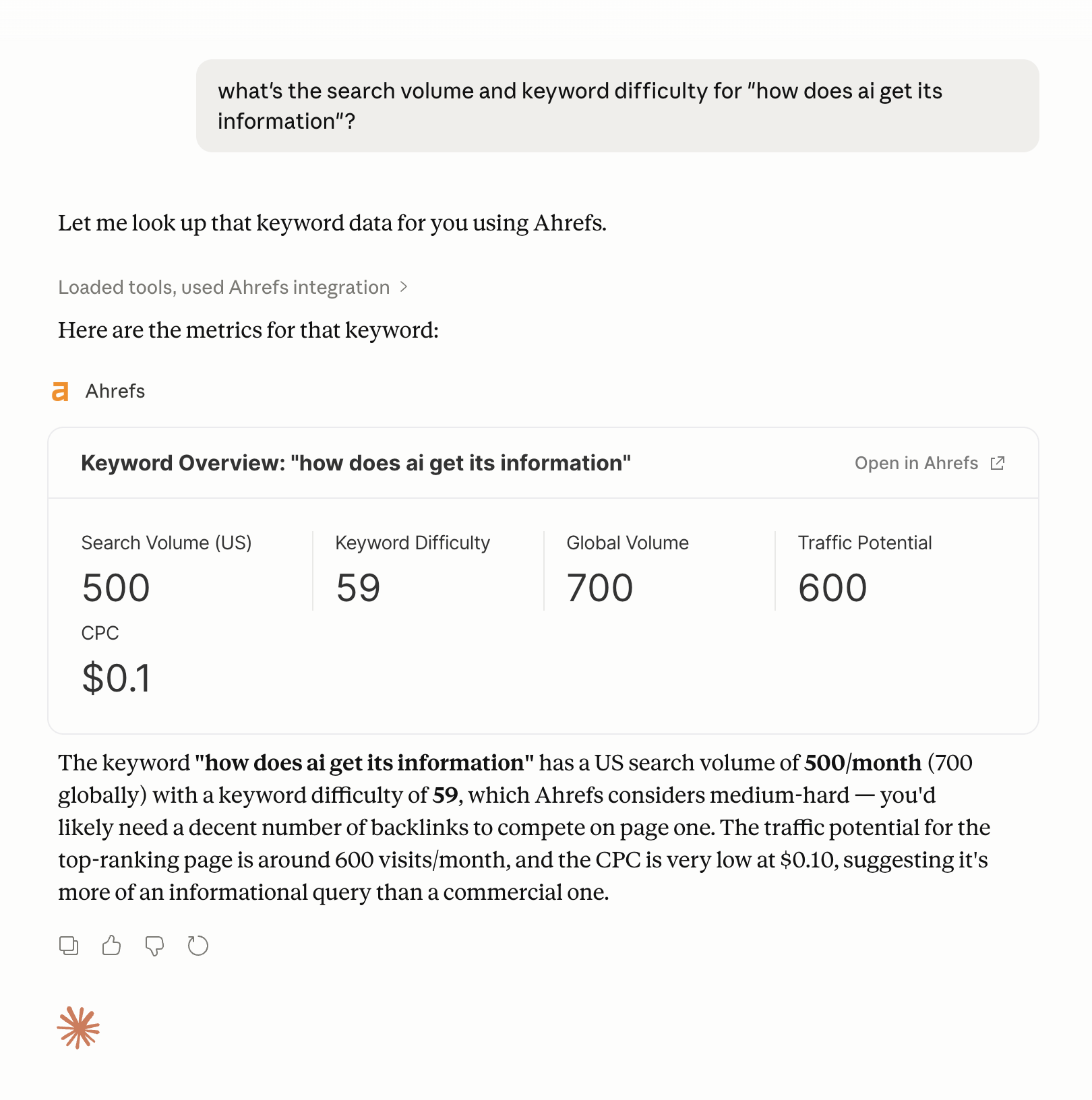
An example of retrieving keyword data using the Ahrefs MCP in Claude.
Try Agent A now
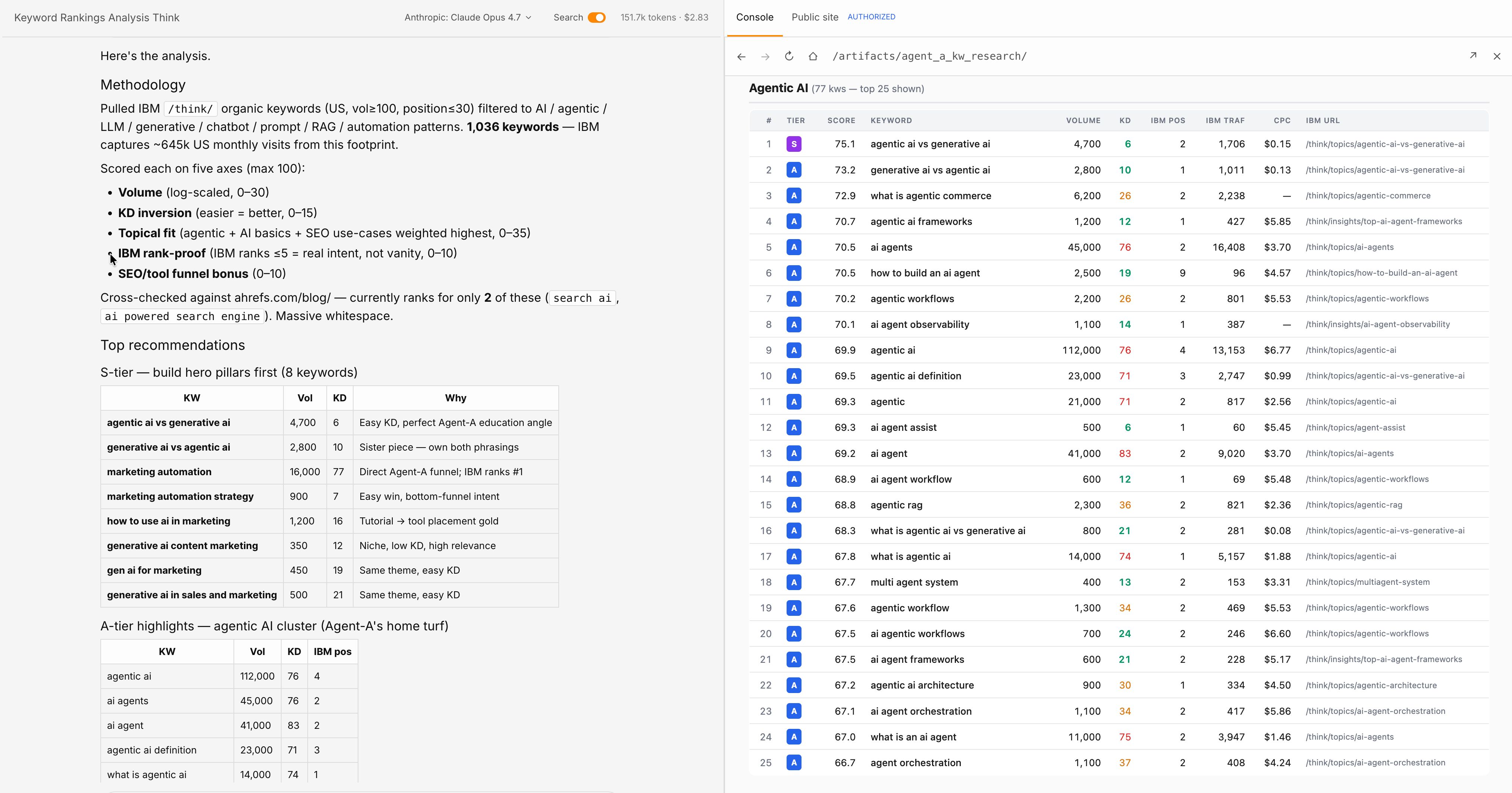
Ahrefs’ Agent A goes one step further. It’s a marketing AI with direct, unlimited access to Ahrefs’ entire internal data set: keyword data, site metrics, competitive intelligence, everything.
Instead of an AI having to approximate SEO insights from training data (which is outdated) or fetching them from public sources (which are incomplete), Agent A works with the actual data.
This is a big difference, especially for marketing and SEO tasks: Agent A can handle many SEO and marketing workflows without having to do anything himself.
The broader principle is that tool-enhanced AI is only as reliable as the tools it invokes. If the API returns bad data, the AI will confidently provide a bad answer. The intelligence of the model does not save you from unnecessary input. It extends the reach of the model far beyond what a training dataset could cover.
By understanding where the AI gets its information from, you’ll know where your brand needs to appear to have the best chance of getting a mention:
- Off-site mentions. If you want AI to accurately represent your brand, the place to start is not your website, but off-site mentions. Models learn about brands from the sources they’ve trained on: press coverage, third-party reviews, forum discussions, Wikipedia entries, and quotes in authoritative publications. A brand that only exists in its own domain is largely invisible to the model’s training data.
- Query fanout. Beyond brand awareness, you need to think about query fanout, the adjacent questions that AI systems generate around a core topic. A brand ranking for “project management software” should also target content like “how to do a sprint review” or “Agile vs. Waterfall,” because these are the questions an AI system raises when a user follows up on the first request. Creating content that covers the entire semantic environment of your core topics increases the chances of you appearing in this extension.
- AI accessibility. Technical accessibility also continues to play a role. Clean HTML, fast loading times and a well-configured robots.txt file influence whether AI crawlers can even read your content. llms.txt is a proposed standard to help LLMs navigate your website’s structure, but as of 2026, no major LLM provider has confirmed that they respect it (so don’t waste your time).
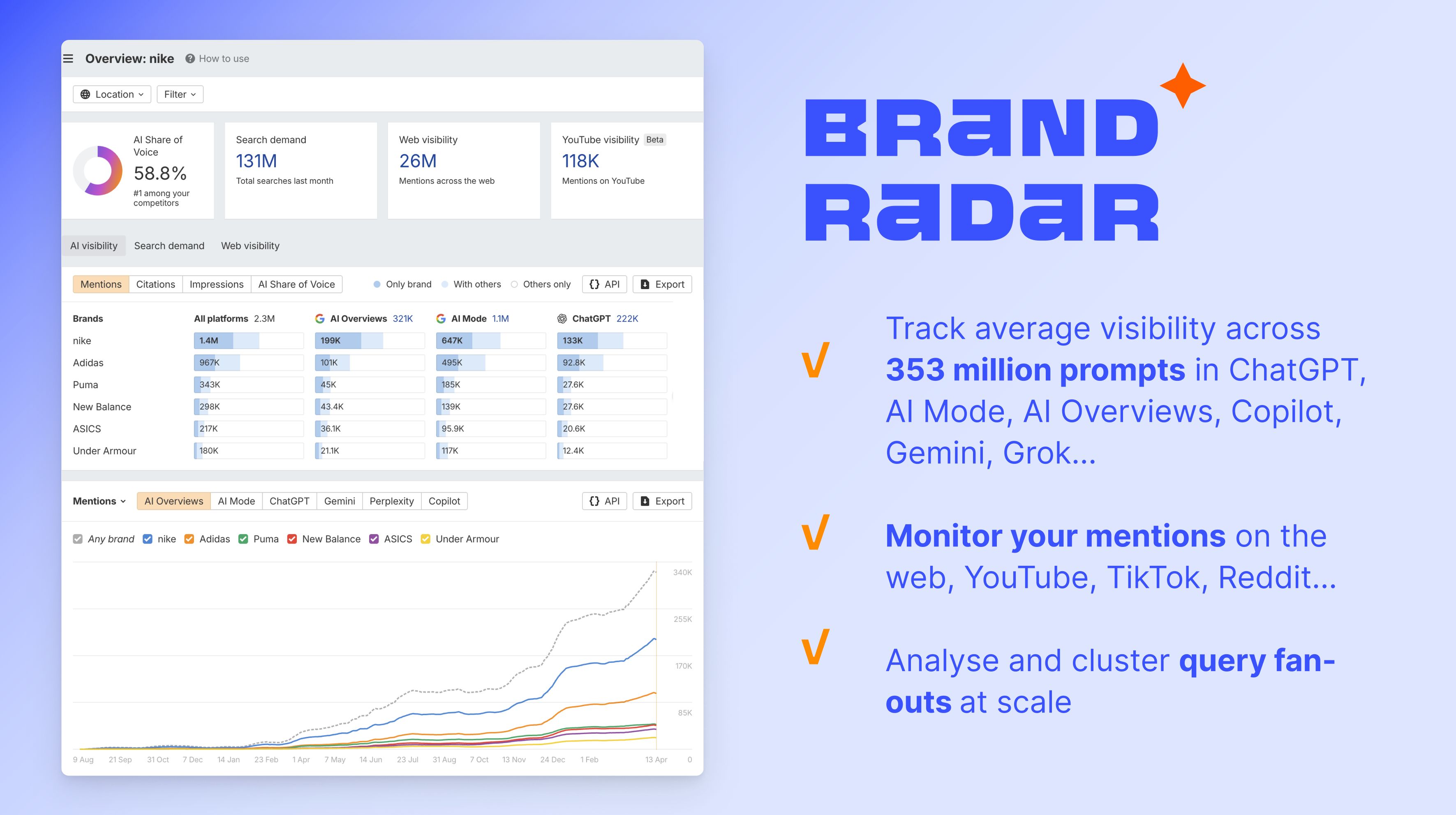
Start tracking AI visibility with Brand Radar
To measure how this works in practice, Ahrefs’ Brand Radar tracks AI share of voice in ChatGPT, Gemini, Perplexity, AI Overviews, AI Model Grok and many more, showing how often your brand is mentioned in AI-generated responses compared to competitors. Read this article to learn how it works.
Final thoughts
AI knowledge comes from three levels: frozen training data, retrieved live documents, and connected external tools such as APIs and MCPs. Each has a different accuracy profile, a different relationship to timeliness, and a different mode of failure.
Training data is the basis – extensive, expensive and static. RAG and grounding increase currency at the expense of polling reliability. Tool integrations like Ahrefs’ MCP and purpose-built agents like Agent A go one step further, giving AI access to relevant live data exactly when it is needed.
For more information on how AI search engines stitch these layers together to generate answers, see our guide to how AI search engines work.
Follow us on Facebook | Twitter | YouTube
WPAP (907)
