Over the past year, Google has significantly accelerated its investment in artificial intelligence and machine learning across its products and platforms. While most marketers are familiar with ChatGPT, Google has continued to develop its own AI capabilities in parallel, including the relaunch of Bard as Gemini and the continued rollout of AI-powered features on Google Play.
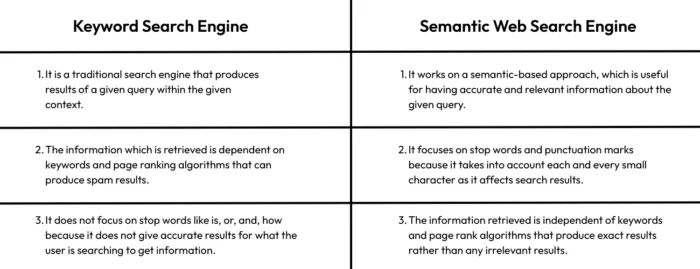
For app marketers and ASO specialists, these developments are not abstract. They represent a fundamental shift in the way apps are understood, categorized and presented to users. Google Play no longer relies primarily on keyword matching. Instead, it’s about a deeper, semantic understanding of apps, their functionality and the problems they solve.
This development raises an important question. As Google increasingly generates, interprets and evaluates app metadata itself, how do ASO teams maintain control, differentiation and long-term competitive advantage?
An underused answer lies in a tool that has been around for years but is rarely discussed in the ASO context: Google Natural Language.
Key insights
- Google Play is moving away from keyword density and toward semantic understanding powered by machine learning and natural language processing.
- Google Natural Language provides valuable insights into how Google interprets app metadata, including entities, sentiment, and category relevance.
- Optimizing for category trust and entity relevance can improve keyword coverage and resilience to algorithm updates.
- ASO teams that align metadata with user intent and natural language patterns are better positioned for long-term detection performance.
- Using tools like Google Natural Language helps future-proof ASO strategies as automation and AI-driven ranking signals continue to increase.
Why traditional ASO signals are losing their effectiveness
Before we explore how Google’s natural language can support ASO, it’s important to understand the broader changes in Google Play’s ranking algorithms.
Over the last two years, Google Play has evolved from frequent, visible algorithm fluctuations to a more continuous learning model. While ASO teams still see volatility, it is now caused less by discrete updates and more by ongoing recalibration as models ingest new behavioral, linguistic and performance data. Reindexing events still occur, but they are increasingly associated with semantic reevaluation rather than simple metadata changes.
At the same time, the effectiveness of traditional optimization measures such as keyword density, exact match repetitions and rigid keyword placement continue to decline. These tactics no longer align with the way Google Play evaluates relevance.
Like Google Search, Google Play is now consistently optimized for meaning, not mechanics. Its systems are designed to understand intent, function and audience context rather than relying on superficial keyword signals. The algorithm is increasingly capable of recognizing what an app does, who it serves, and what problems it solves, even when those ideas are expressed in varied, natural language.
This is where natural language processing becomes a central part of modern ASO tools and practices.
What is the goal of Google Natural Language?
Google Natural Language is designed to help machines understand human language in a way that more closely matches human interpretation. It supports a wide range of Google products and features, including sentiment analysis, entity recognition, content classification, and context understanding.
In practice, it analyzes a body of text and identifies:
- The general mood and tone.
- Key entities and their relative importance.
- The categories and subcategories that the content most closely matches.
This presents a rare opportunity for ASO teams. Instead of guessing how Google might interpret app metadata, it provides a proxy for understanding how Google’s machine learning systems read and categorize text.
When used correctly, it can help ASO specialists better align metadata with Google’s evolving ranking logic.
How Google Natural Language applies to ASO
When applied to app metadata, Google Natural Language can reveal how Google is likely to associate an app with specific concepts, categories, and keyword topics. This insight is particularly valuable because keyword density is less influential and semantic relevance takes precedence.
Below are the key components that are most important for ASO.
Sentiment analysis
Sentiment analysis assesses the emotional tone of a text and categorizes it as positive, negative or neutral. While sentiment isn’t a primary ranking factor for app discovery, it does provide useful contextual information.
For example, excessively promotional, aggressive or unclear language can lead to disruptions in the metadata. By reviewing sentiment output, teams can ensure that descriptions maintain a clear, neutral, and informative tone that supports both user trust and algorithmic interpretation.
Recognition and meaning of entities
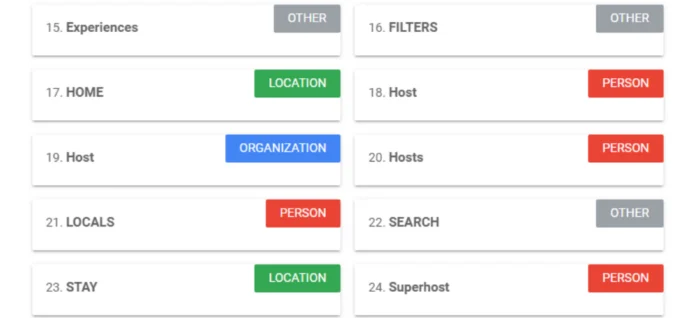
Entity recognition identifies specific entities within a text and classifies them into predefined types such as company, product, feature or concept. Each entity is assigned a saliency value that reflects how central that entity is to the overall content.
In an ASO context, entities could include:
- Core functions of the app
- Functional use cases
- Industry-specific terms
- Recognizable product or service concepts
The saliency values range from 0 to 1.0. Higher values indicate that an entity plays a more important role in defining the content.
From an optimization perspective, this is crucial. If key features or use cases are not highlighted, it suggests that Google may not strongly associate the app with those concepts.
Strategically integrating relevant entities into metadata in a natural, user-centric way can improve clarity and strengthen topical relevance. Placement is also important. Important entities that appear early in descriptions or are reinforced toward the end of the text tend to carry more weight.
Categories and confidence values
Category classification is arguably the most powerful element of Google Natural Language for ASO.
When text is analyzed, it is assigned to one or more categories and subcategories, each of which is assigned a confidence value. These values indicate how closely the content corresponds to a particular category.
This has significant implications for Google Play. Higher category confidence increases the likelihood that an app will be associated with a wider range of relevant searches within that category. Instead of ranking for a narrow set of exact keywords, apps can gain visibility in an expanded semantic keyword space.
In practice, we’ve seen that improving category reliability can significantly improve keyword coverage and ranking stability, especially during times of algorithm changes.
How to increase category trust:
- Use clear, natural language that reflects the user’s actual intent
- Focus on describing functionality and value, not just features
- Avoid keyword stuffing or forced wording
- Consistently reinforce category-relevant concepts across all metadata

Applying GNL insights to metadata strategy
The true value of Google Natural Language lies not in isolated analysis, but in iterative optimization. By repeatedly testing draft metadata using Google Natural Language, ASO teams can refine the language until category security, entity meaning, and overall clarity improve.
This approach fits well with the broader 2026 ASO Best Practices, which emphasize:
- User intent via keyword lists
- Semantic relevance instead of repetition
- Long-term stability over short-term gains
Insights into the case study
We applied GNL-driven optimization techniques across multiple app categories. Although results vary by industry, the overall pattern is consistent.
During times of significant Google Play algorithm updates, apps optimized for category trust and entity relevance demonstrated greater resilience. In several cases, visibility improved despite widespread volatility elsewhere in the business.
In one example, keyword coverage expanded significantly after metadata updates, increasing confidence in both a core category and secondary related categories. This resulted in a more than fivefold increase in organic Explore installs over time.
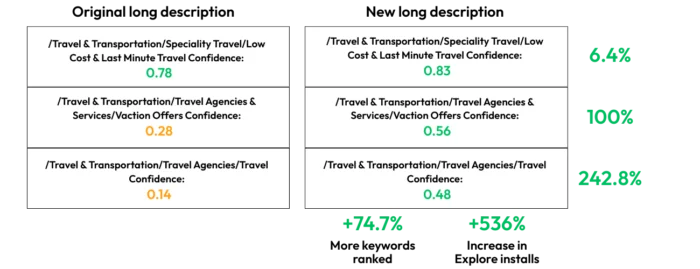
These results reinforce an important principle. When ASO strategies are aligned with how Google understands language, they are better positioned to benefit from, rather than be disrupted by, evolving algorithms.
Connect GNL with the ASO Strategy 2026
Looking forward, the role of natural language processing in app discovery will continue to increase. As Google continues to automate the creation and interpretation of metadata, manual optimization will shift from mechanical execution to strategic leadership.
ASO teams that understand and use tools like Google Natural Language are better equipped to:
- Direct AI-generated content instead of reacting to it
- Maintain differentiation in an increasingly automated ecosystem
- Create metadata that supports both paid and organic discovery
This approach also complements broader trends such as AI-powered search, cross-platform discovery, and privacy-focused measurement frameworks.
Diploma
The rise of natural language processing does not mean the end of ASO. Rather, it marks a change in the approach to optimization.
By going beyond keyword density and considering semantic relevance, ASO teams can better adapt to Google’s evolving algorithms. Google Natural Language provides a practical way to understand how app metadata is interpreted and how it can be improved to support discovery, conversion, and long-term stability.
As automation continues to increase in Google Play, the teams that will be successful will be those who understand the systems behind them and adapt their strategies accordingly. Natural language optimization is no longer optional. It will become a mainstay of the modern ASO.
Follow us on Facebook | Twitter | YouTube
WPAP (697)
