
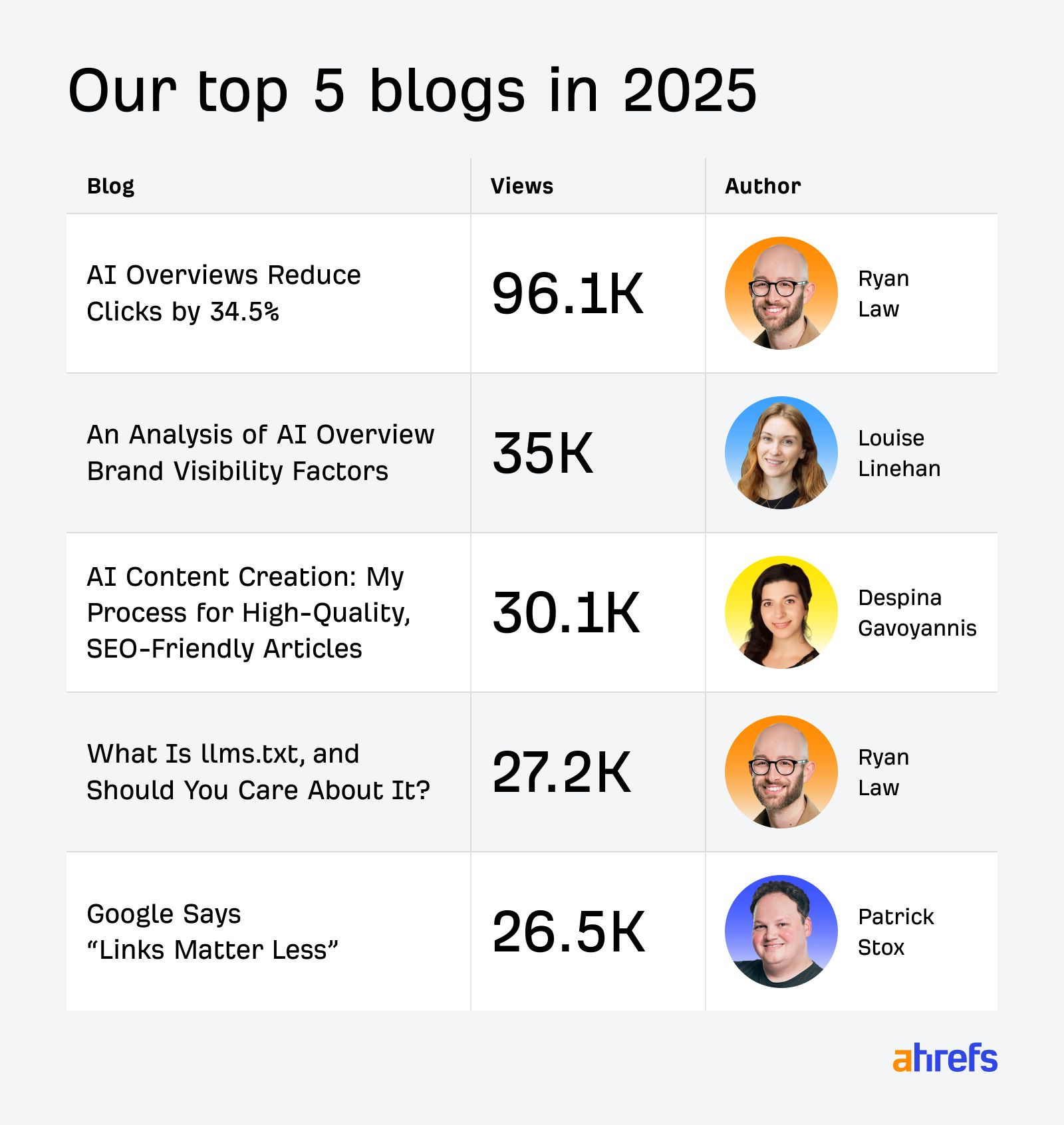
We’re sharing the content that helped us the most in 2025 to give you an idea of what might work for you in 2026.
And of course we wanted to remind you of some of our best blogs 😉
Below we used Ahrefs Web Analytics to find our most viewed articles from 2025.
We were inspired by Amanda Natividad’s SparkToro post. Great stuff from Amanda as always – check them out for more content ideas!
In 2025, three of our top five most visited articles were research studies created using data from Ahrefs.
The remaining two included an SEO blog and an article generated almost entirely by AI.
Side note.
We filtered out blogs published before 2025 or updated in 2025.
Let’s get started…
According to Ahrefs Web Analytics, “AI Overviews Reduce Clicks by 34.5%” was our most viewed article overall, driving approximately 96,000 visits since its publication in April.
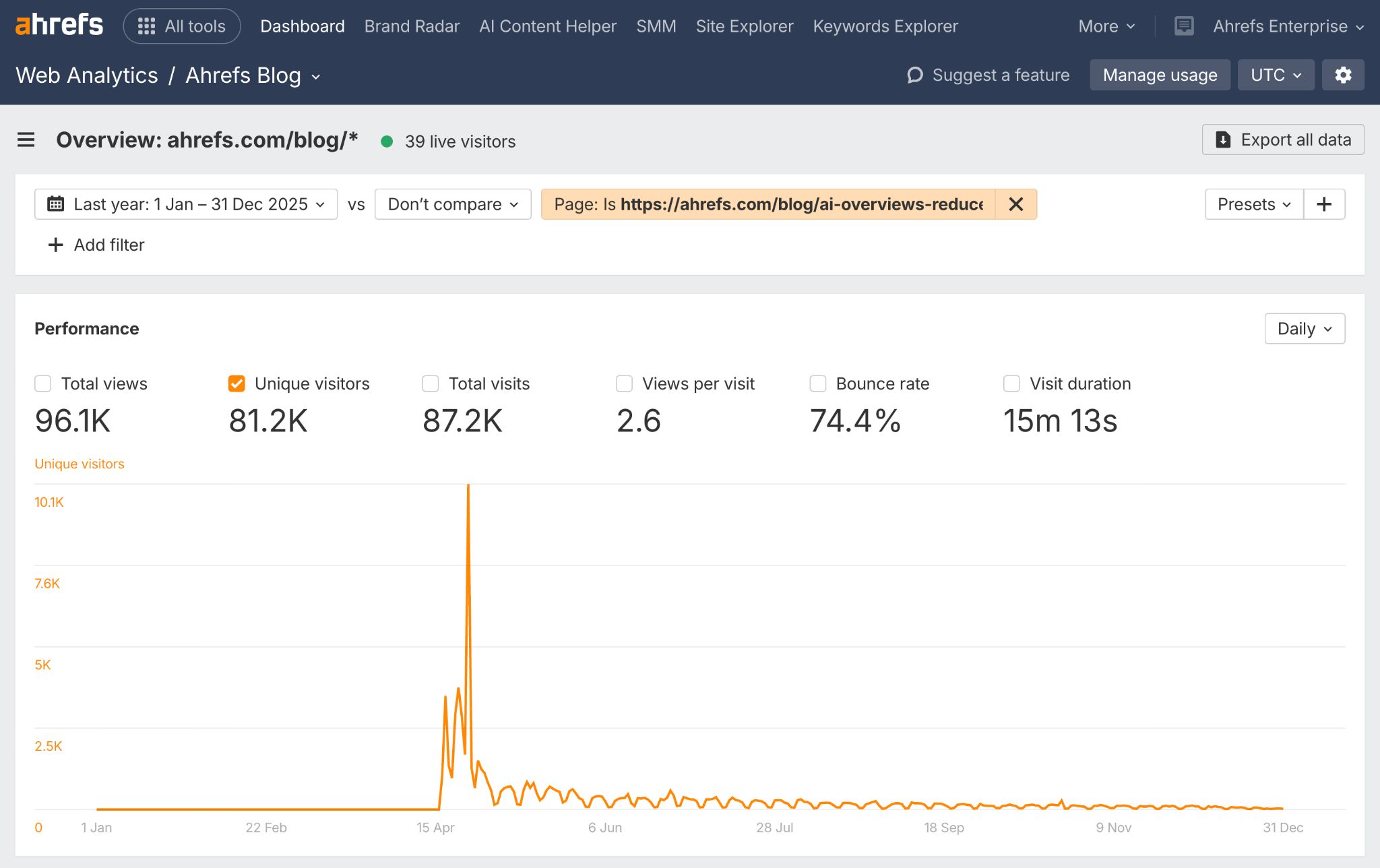
This research used our first-party data to answer the question every SEO has been asking this year: How much traffic are AI overviews actually stealing?
We analyzed 300,000 keywords and found that the highest-ranking page receives 34.5% fewer clicks when an AI overview is displayed, compared to similar searches without it.
By comparing click-through rates before and after the launch of Google’s AI Overview, we measured the real impact: #1 position for informational keywords dropped from 0.056 CTR to just 0.031 after AI Overviews were released.
The data confirmed what many of us had suspected: AI overviews significantly reduce traffic to top-ranking pages, even if those pages still hold the top spot.
An analysis of brand visibility factors in the AI overview (75,000 brands examined) came in second place. I wrote this study to confirm once and for all whether PR and external brand mentions were the most important factor in AI visibility.
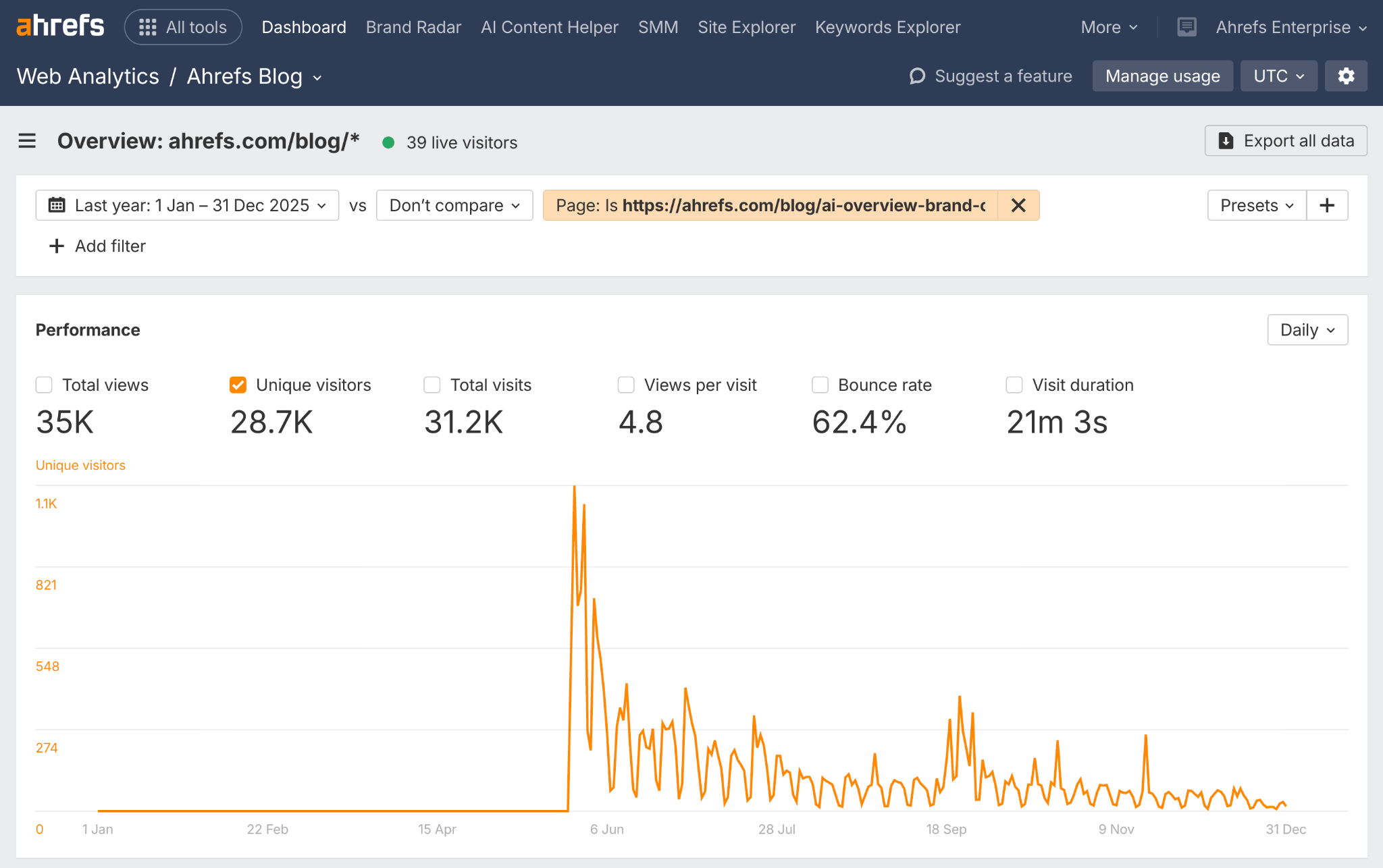
It was a theory I heard everywhere at the time, but I (as it turned out, like others) wanted to see the cold, hard data. Together with Ahrefs data scientist Xibeijia, I analyzed 75,000 brands to assess how eleven different brand search factors correlate with AI Overview visibility – we have since repeated this study for ChatGPT and AI Mode.
Our greatest discovery? Branded web mentions Do correlate highly (0.664) with AI Overview presence – more than any other factor, including backlinks or domain rating.
We also found that if your brand is in the bottom 50% of web mentions, you are virtually invisible to AI systems.
AI Content Creation: My Process for High-Quality, SEO-Friendly Articles was our third most viewed blog, receiving approximately 30,000 views.
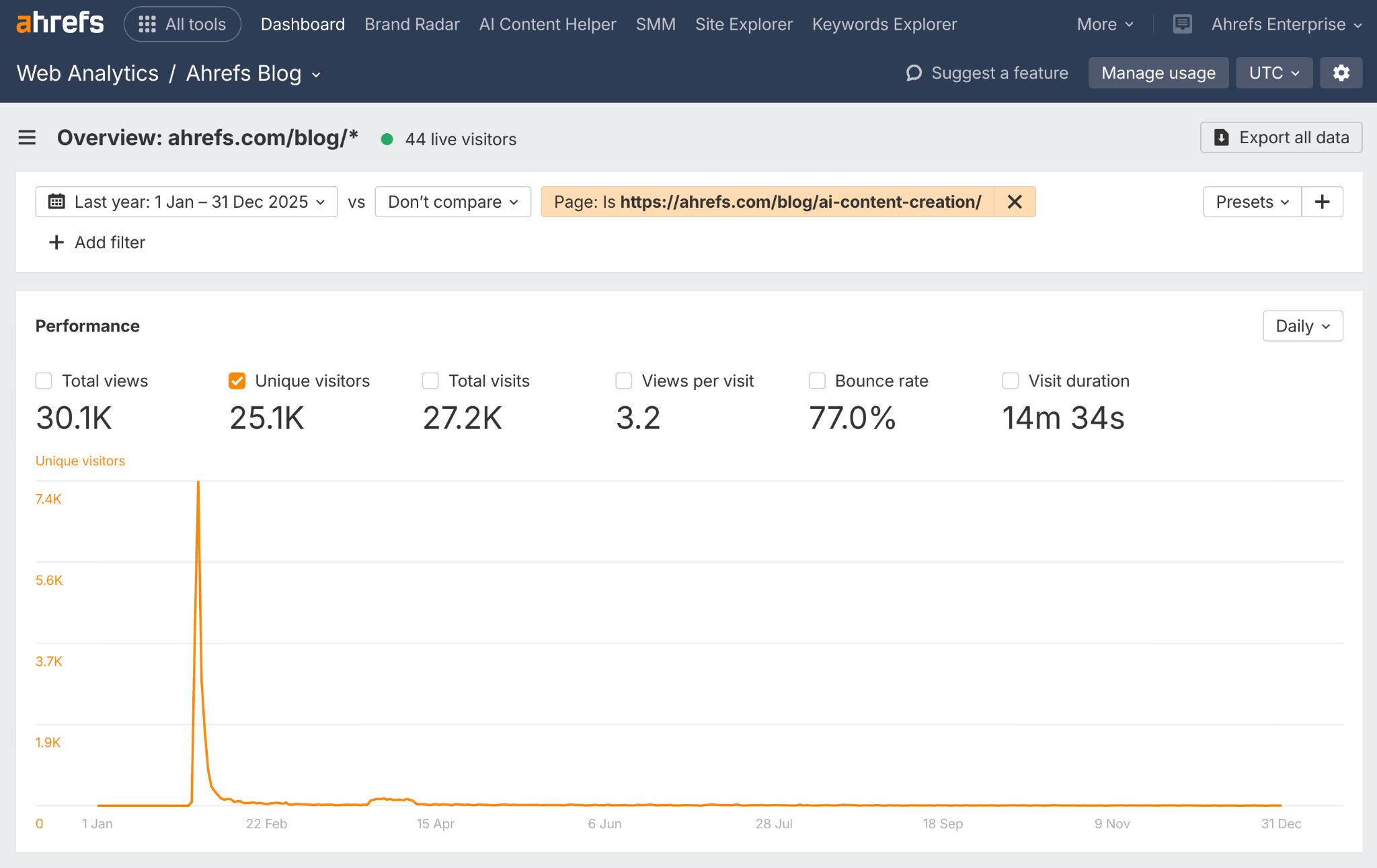
My teammate Despina Gavoyannis created this handy SOP (Standard Operating Procedure) for marketers looking to integrate AI into their content workflows.
This guide is about her exact process for using AI as a tool – not a replacement – for creating content that gets ranked.
The post covers everything from finding rankable keywords and identifying search intent to adding original information that AI can’t generate on its own.
Despina’s SOPs performed particularly well via Google Discover traffic…
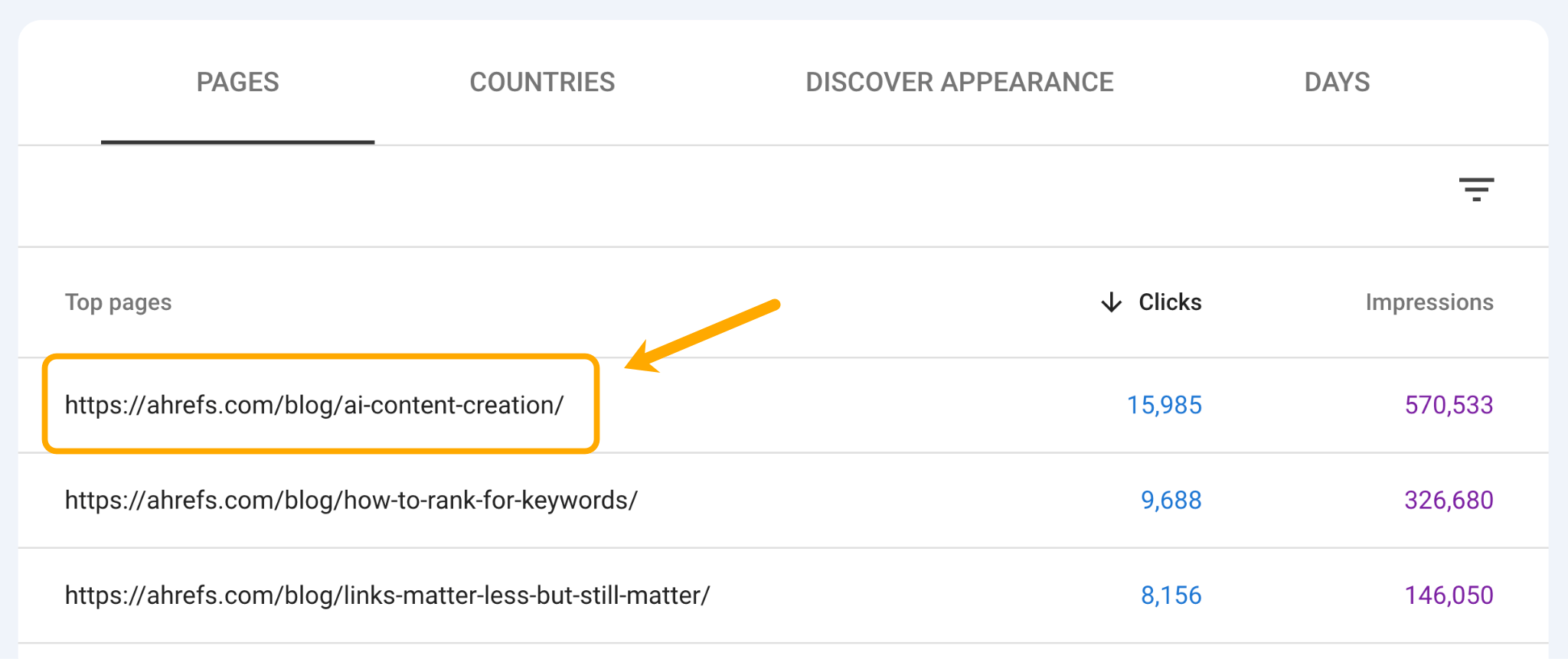
Google Discover users seem to be deeply engaged with practical step-by-step SOPs that help them complete real-world tasks.
What is llms.txt and should you care about it?: Ryan wrote this explanation in just a few hours using ChatGPT. Now it is our fourth most viewed blog in 2025.
Not bad 😉
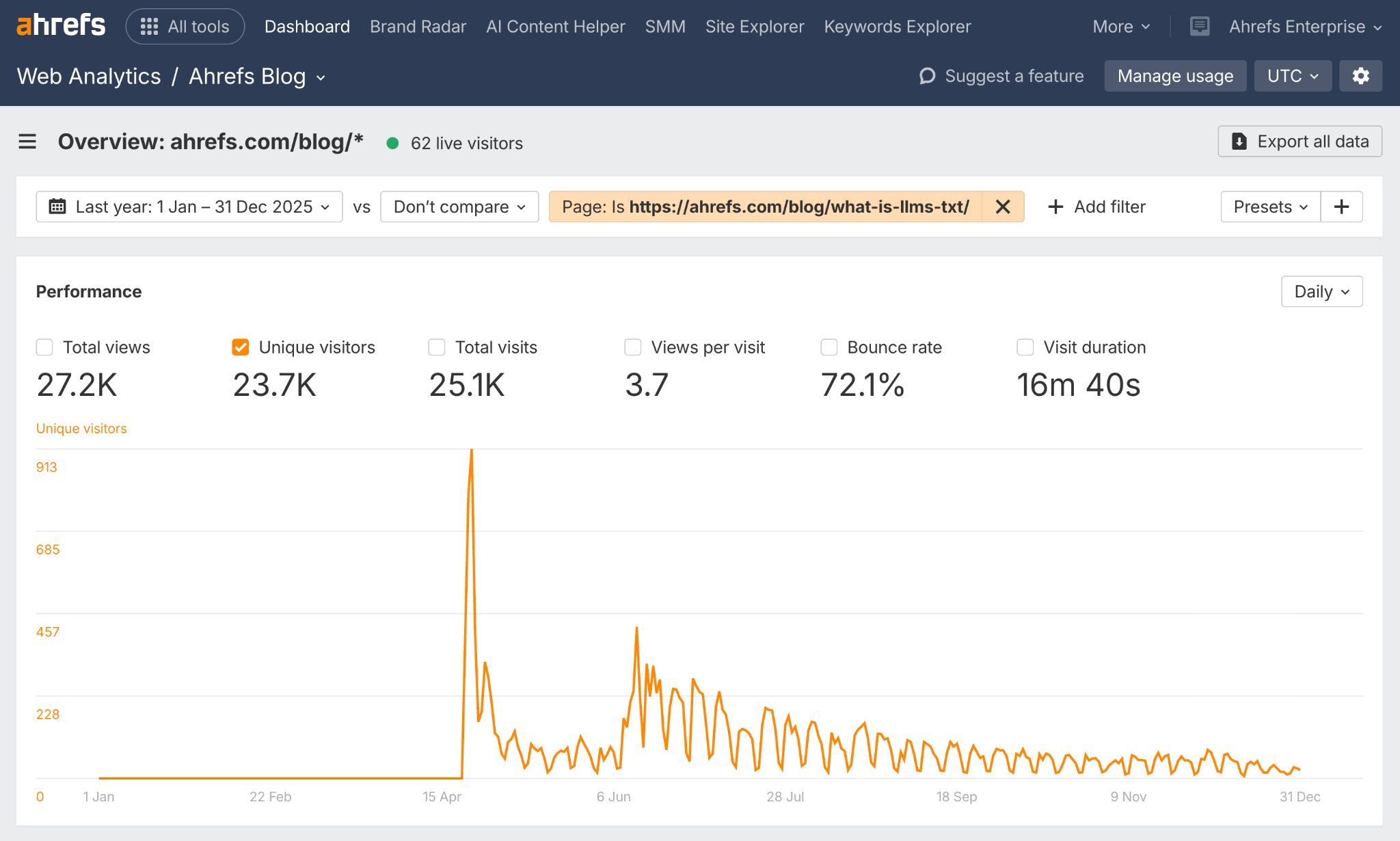
The post explains llms.txt, a proposed standard to help large language models understand and access structured website content.
While some developers are experimenting with it, no major LLM provider currently supports it as part of their crawler protocol.
Ryan’s take: It’s a solution in search of a problem.
Search engines already crawl and understand content using existing infrastructure such as robots.txt and sitemap.xml – LLMs largely use the same setup.
In 2025, Ryan built a seven-part AI content process and has since created more than 6 major AI blogs, which have collectively generated approximately 63,000 views to date.
You can see how he does it in the Ahrefs podcast below.
It just shows that AI actually generates content may do well. Use Ryan’s process to tackle trending and emerging topics before your competitors do.
Google Says “Links Are Less Important” – We looked at 1,000,000 SERPs to see if this is true: Google has been telling SEOs that links are less important than they used to be, and many in the industry have accepted this as fact.
But is it actually true?
Ahrefs technical SEO expert Patrick Stox decided to settle the debate with data.
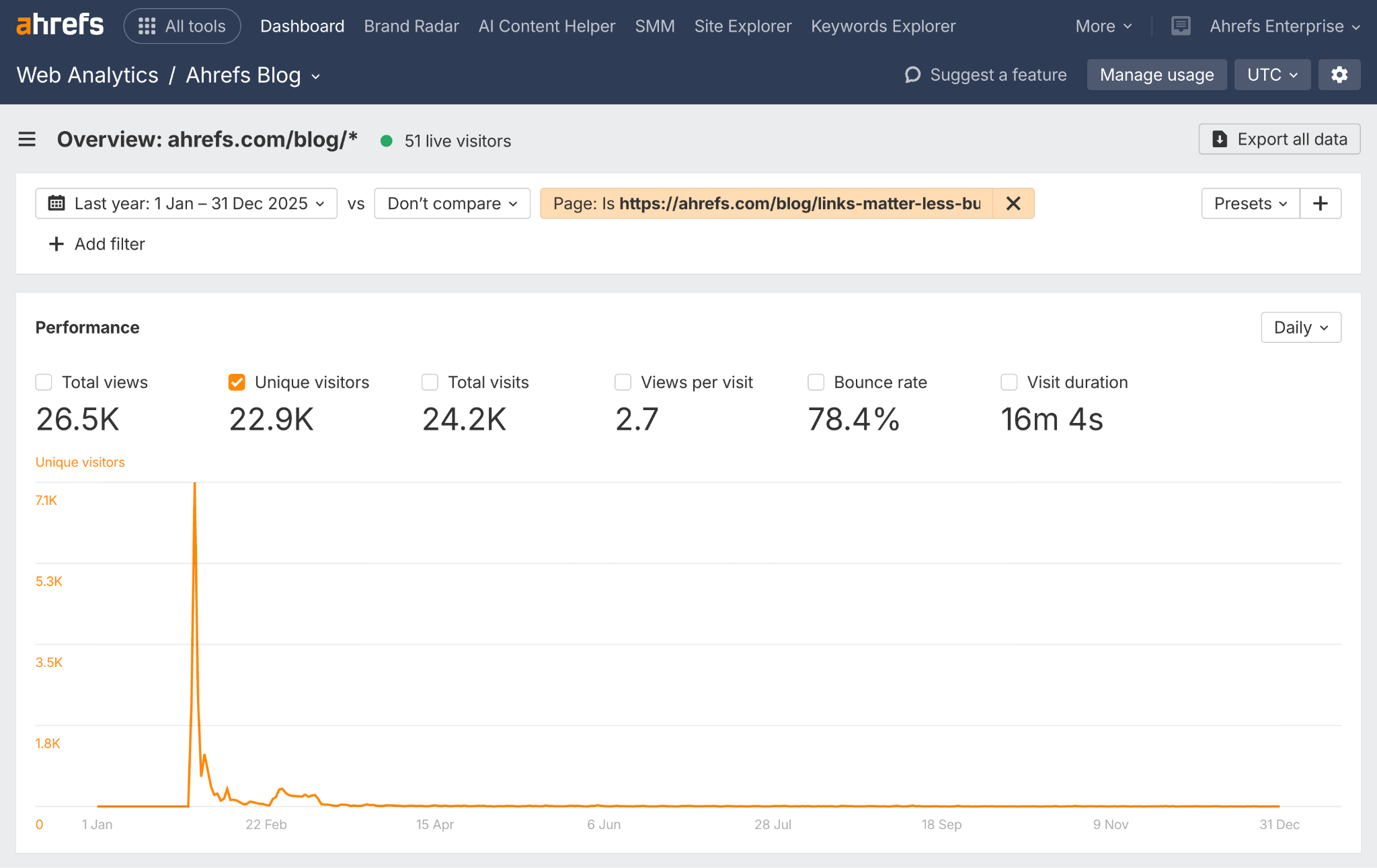
He analyzed the top 1 million keywords by search volume and calculated Spearman correlations between SERP rankings and 20 different SEO metrics, including domain rating, backlinks, referring domains, and internal links.
And guess what? Links still matter – a lot.
Although the correlation has decreased slightly since a similar 2019 study (from 0.27 to 0.21 for total backlinks), links remained one of the strongest ranking signals, especially for highly competitive, high-volume searches.
The research also showed that links are even more important for informational content, local searches and branded searches.
Even though Google has publicly concealed the meaning of links, the data tells a different story.
Similar to the SparkToro team, most of our top content in 2025 was research-based.
Actually, 56% of our most viewed posts (on all channels) were research blogs.
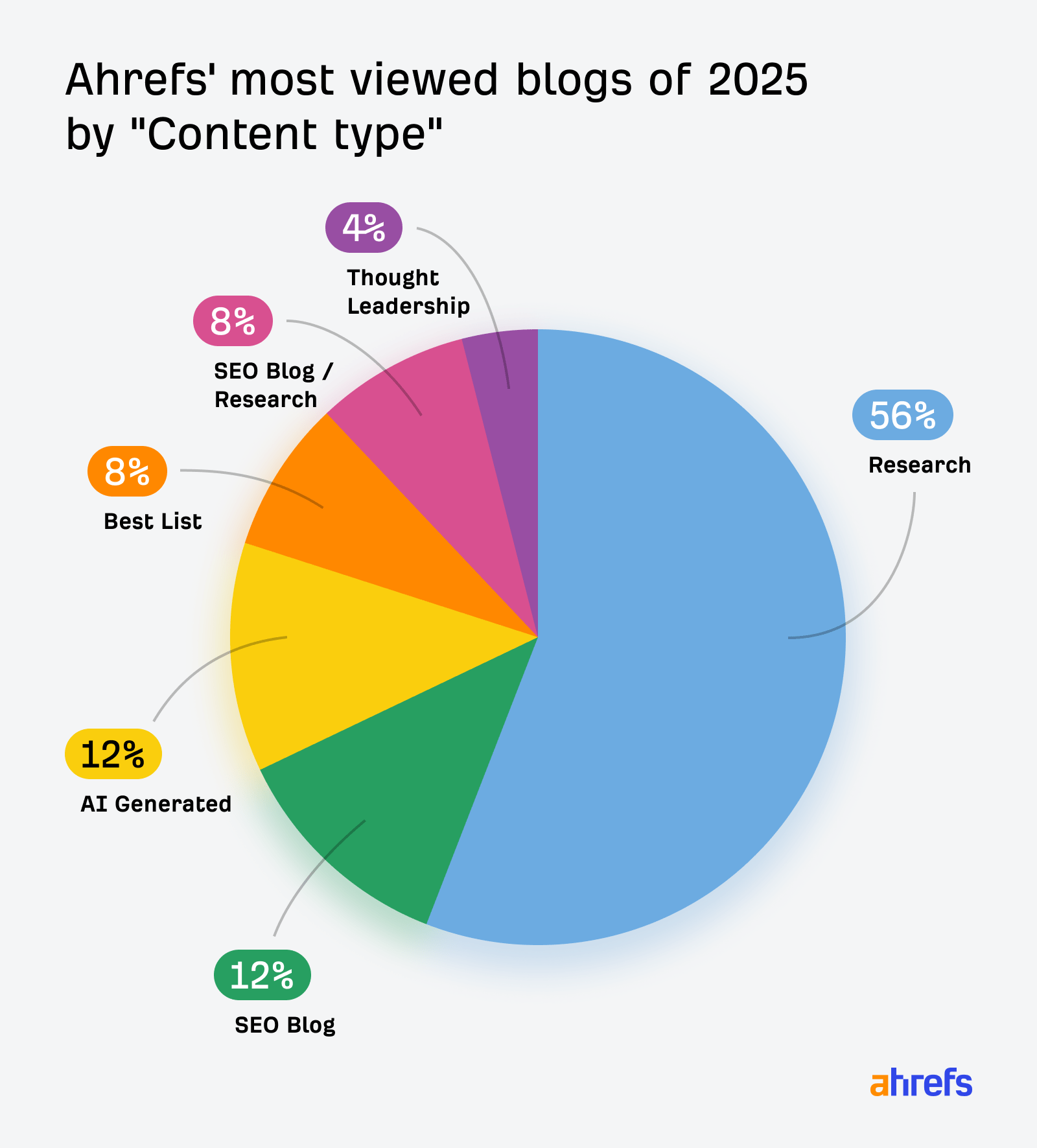
Our top 5 articles also tended to differ slightly from source to source.
Here are our top performers in organic search, AI search, direct search and social media.
Top blogs by search traffic
Top blogs by AI traffic
Top blogs by direct traffic
Top blogs by social traffic
Final thoughts
Here’s what we learned from our top blogs of 2025…
- People are skeptical about test statements: When official narratives don’t match what people see in real life, data-driven research will get your attention. This is why Patrick’s research was so widely noticed – it provided concrete data that challenged Google’s narrative.
- Choose debates that people care about: The best research answers questions that your audience is actively debating, not ones you think they should care about.
- Find out early about trending topics: Many of these posts worked because they addressed trending topics early. Some didn’t even have a search demand when we started writing about them – we just stayed on the ground on social media and in communities and wrote about the topics that stimulated discussion. Over time, these topics naturally gained search volume. That’s why 4 of our top 5 articles were also our most viewed articles in search.
- Don’t be afraid of AI-powered content: One of our top posts was created in an afternoon using ChatGPT and still attracted large amounts of traffic. For hot topics or simple explanations, AI can get you 80% of the way there – just add your changes, add some original examples, and send it out.
- Give people SOPs to steal: Not everything has to be a data study. Step-by-step processes that people can actually follow and adapt to keep their own work performing well.
- Use data that no one else has access to: Three of our top 5 posts used Ahrefs’ first-party data to answer questions no one else could. If you have protected data or access to information that other people don’t have, use it. Whether it’s customer surveys, internal sales metrics, support ticket trends, user behavior analytics, financial data, or even aggregated insights from customer work, unique data gives you a competitive advantage that can’t be replicated.
When it comes to AI, the only certainty is uncertainty. What worked in 2025 may no longer work in 2026. But that’s exactly why we’ll continue to share what we’ve learned!
Follow us on Facebook | Twitter | YouTube
WPAP (907)
